New Digital Preservation Librarian
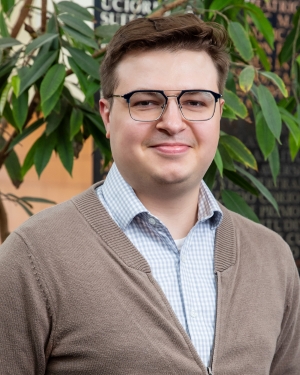
Jeremy Davet is the new digital preservation librarian at UH Libraries.
University of Houston Libraries is pleased to welcome Jeremy Davet as the new digital preservation librarian.
Please describe your role. How does your work align with the student success and research productivity focus of the University?
As the Digital Preservation Librarian for the University of Houston and its libraries, my responsibilities primarily include implementing and periodically amending the UH Libraries Digital Preservation Policy to reflect best practices; managing the Archivematica digital preservation system; and facilitating access to and the use of outmoded digital file types and storage media. When a student’s information-seeking leads them back to the earlier days of personal computing, effective digital preservation will ensure that they can find and use what they are looking for.
Please share a bit about your background and professional interests. How do these inspire and shape your approach to preservation?
Before I started on my current path, my academic background was in cultural anthropology and archaeology. In my experiences navigating divides in language, lived experience, and time, I came to appreciate how much we stand to lose owing to misunderstanding and misremembrance. It was my desire to reveal and preserve the past that took me into libraries and archives – and that’s where you find me today, working to ensure that the archaeologists of tomorrow will be able to uncover the digital artifacts of today. Before joining University of Houston Libraries, I lent my hand to the International Research on Permanent Authentic Records in Electronic Systems (InterPARES), researching the potential benefits and hazards to employing artificial intelligence in memory institutions. More recently, I managed and archived the Artists Documentation Program (ADP), a conservation-focused series of oral histories with artists and their collaborators sponsored by The Menil Collection. In both cases, I was exploring how libraries, archives, and museums can use new technologies to enhance and expand access to their collections, while preserving what makes them authentic and unique.
Taken together, these experiences continue to color my approach to digital preservation: foregrounding the human learning experience, while leveraging emerging technology to improve the quality, quantity, and durability of information.
What are one or two things you’d like faculty, students, and scholars to know about the function/purpose/significance of digital preservation?
Most importantly, that digital preservation is your concern too! Ancient history is not so different from the modern day, insofar as we can only collectively remember what gets recorded. Make sure your work makes it to the next generations by taking simple steps like limiting the length of filenames, regularly backing up your work, and describing your files with metadata. Ensure that you’re adequately safeguarding your files against potential hazards, like hardware failure or natural disasters, and that you’re saving your most important documents in stable, portable formats like PDF.
Announcing the 2025 DH@UH Series
University of Houston Libraries, the Hewlett Packard Enterprise Data Science Institute, and the Digital Humanities Core are pleased to announce the 2025 DH@UH event series. DH@UH serves as a platform for advancing digital humanities research and collaboration across the University, bringing together humanists, data scientists, librarians, and students to foster innovative digital projects, particularly those that forge connections between academic research and public communities.
The University community is invited to attend the following events:
- Monday, February 17, 12 noon – 1 pm, online: State of DH@UH
Linda Garcia Merchant, director of the Digital Humanities Core, and Taylor Davis-Van Atta, head of Research Services at UH Libraries, will discuss the current state and future vision of the DHC as well as the Digital Research Commons, a lab supporting multidisciplinary research in the MD Anderson Library. - Monday, March 3, 12 noon – 1:30 pm, MD Anderson Library Digital Research Commons and online: Public Heritage and Spatial Humanities in the South Texas Borderlands
This presentation will highlight a dynamic academic and professional journey that illustrates René A. Ballesteros’s dedication to leveraging digital platforms with anthropological insights to foster community engagement and cultural heritage preservation. A conversation with Shine Trabucco, PhD candidate in History, and Q&A with the audience will follow. - Thursday, March 6, 11 am – 12 noon, MD Anderson Library Elizabeth D. Rockwell Pavilion: Who Is Your FYP Actually For?: Algorithmic Justice For The Next Generation
A keynote by Dr. Avriel Carinna Epps, computational social scientist and a Civic Science Postdoctoral Fellow at the Cornell University CATLab - Monday, March 24, 12 noon, online (Zoom link forthcoming): ClioVis demonstration and discussion with Dr. Kristina Neumann and ClioVis developer Dr. Erika Bsumek
For more information on DH@UH, contact the Digital Humanities Core.
New Open Publishing Librarian

Xiao Zeng
University of Houston Libraries welcomes Xiao Zeng as the new open publishing librarian.
Please describe your role. How does your work align with the student success and research productivity focus of the University?
My primary focus is to grow student success and enhance research productivity at the University. I oversee the UH Institutional Repository and the Vireo electronic thesis and dissertation management system, which provide seamless access for students and faculty to showcase their academic work. By offering specialized support in open access publishing and guiding our community through publisher agreements, I empower researchers to understand their rights and amplify their scholarly impact.
Collaboration plays a crucial role in my responsibilities. I work closely with various departments and research centers, including the Division of Research and the Hewlett Packard Enterprise Data Science Institute, to tackle emerging publishing challenges. Initiatives like Cougar ROAR and our open monograph publishing efforts ensure that our research outputs are accessible to a global audience, thereby advancing the University’s mission of knowledge dissemination and supporting the academic and research endeavors of our community.
Please share a bit about your background and professional interests. How do these inspire and shape your approach as a librarian?
I earned a bachelor’s degree in Architecture from the University of Illinois at Urbana-Champaign (UIUC), followed by a Master of Science in Library and Information Science (MSLIS) from the same institution. My academic experiences have cultivated a strong appreciation for interdisciplinary studies and the fusion of diverse fields of knowledge. While serving as a graduate assistant at UIUC, I developed a deep interest in how library tools and current trends can facilitate research and improve information access. This background heavily influences my approach as a librarian, where I emphasize understanding users’ information-seeking behaviors and analyzing their needs to fill gaps in library research services.
Personally, I am passionate about supporting both students and faculty to succeed in their academic and research pursuits, especially in the areas of open access, scholarly publishing, and information management. My goal is to nurture a supportive environment that promotes information literacy and resource access. My experiences inspire me to be an active librarian who encourages collaboration and seeks to improve educational and research outcomes across various disciplines. By bridging the divide between library services and user needs, I aim to ensure that our community has the tools and resources necessary to navigate an increasingly complex information landscape.
What are one or two things you’d like faculty, students, and scholars to know about the function of open publishing in Research Services?
One critical aspect of open publishing in Research Services is its role in enhancing the accessibility and visibility of research outputs. By supporting open access, we encourage faculty, students, and scholars to share their work with a global audience free from paywalls, prompting greater collaboration and knowledge sharing. This approach not only elevates individual research but also aligns with the University’s mission of furthering education and public understanding.
Moreover, we offer wide support throughout the publishing process, including guidance on navigating publisher agreements, exploring open access options, and ensuring compliance with funder policies. This extensive assistance empowers our academic community to make informed decisions about their publications, ultimately boosting their research impact and helping them succeed in their scholarly pursuits.
Visit Research Support to learn more about UH Libraries’ research services.
DRC Advances Student Success and Research Productivity

Digital Research Commons is located on MD Anderson Library floor 2.
University of Houston Libraries Digital Research Commons (DRC), located on MD Anderson Library floor 2, is a space for collaborative work that provides access to resources and technology for students, scholars, and faculty engaged in a broad range of research.
UH students are encouraged to explore the variety of options available to them in the DRC, which offers recently upgraded, high-powered group workstations with a wide range of software, a professional podcasting studio, and a large, customizable space suited for hosting in-person and hybrid events.
Over the past year, use of the DRC has steadily increased, said Danny Fuller, DRC manager.
“We’ve hosted a lot of lectures, conferences, and limited-run programming as well as podcasting,” Fuller noted. “During the past five months, we have had over 370 students, faculty, and staff come through the DRC. Two highlights were the Summer Internship in Public History and Digital Humanities, organized by the Center for Public History, and a Mini-conference on Modal Logic and Connectionism hosted by Cameron Buckner, professor of philosophy. Additionally, the podcast studio has been used regularly by students and faculty for coursework and research purposes.”

A podcast station is available in the DRC.
Most importantly, the DRC and its wealth of resources are freely available to all members of the UH community to use in any academic pursuit, regardless of major or program. The DRC benefits everyone, from students who are new to conducting research to seasoned scholars needing access to tools they may not be able to find elsewhere on campus.
The DRC is accessible during open hours, and can also be used by request via the DRC website or by emailing [email protected].