UH Libraries Announces Acquisition of the Lawrence Welsh Archive
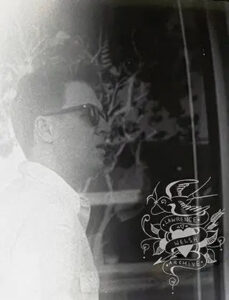
University of Houston Libraries is pleased to announce the acquisition of the Lawrence Welsh Archive, an extensive collection of Welsh’s papers, which include photographs, drafts, ephemera, journals, correspondence, and much more.
Poet, punk musician, journalist, and professor Lawrence Welsh is a first-generation Irish-American from Los Angeles whose work is deeply rooted in the American Southwest. His collection captures the scope of his travels throughout California, New Mexico, and Texas, as well as the music, poetry, reporting, and other writings those travels inspired.
UH Libraries reached out to Lawrence Welsh to ask him about his papers being added to the library’s special collections.
What inspired you to make your papers available to UH Libraries?
Mary Catherine Kinniburgh from Granary Books called in early 2026 to say the University of Houston showed interest in buying my papers. She asked if I’d be up for the development. My answer arrived immediately.
“Yes,” I said, since I had lived in Texas for 31 straight years. But my answer encompassed more than just time and geography.
In 1989, looking for a new direction in life, I hitchhiked to Texas from Los Angeles, California, where I was born and raised. After spending time in El Paso and San Antonio, I settled down in Houston and became a waiter at the On the Border Café in Montrose. Those days changed and rearranged my life.
Back then, I was already a veteran newspaper reporter and editor, but I was living a dead-end life and knew I needed to go searching for new experiences and openings.
And that’s exactly what occurred in Houston.
Decades later, I married a native Texan, Lisa McNiel, who took classes at the University of Houston in the 1980s and holds degrees from Trinity University in San Antonio and the University of Texas at El Paso.
In the final analysis, we realized we both lived in Houston at the same time, but, of course, we never met back then. That occurred six years later in El Paso, while we were both in graduate school.
In the end, Houston served as ground zero for the unrivaled possibilities of a new life. Nowadays, on the eve of my 14th book being published, I’m still thankful for entering this new world.
What stories/themes emerge from the collection?
The main theme of the collection is the story of a poet, writer, and musician who was burning to create and has kept the fire going for more than 50 years.
Another theme is the power of letter writing, since the collection houses 30,000 letters and 150 personal journals. The letters dive into the power of “the moment and the day,” and I’m grateful for every writer, editor, poet, publisher, musician, artist, friend, and family member who took the time to join in an epistolary relationship with me.
Another theme that emerges is the almost unquantifiable magic and grit of the Southwest, including Texas, Mexico, New Mexico, and Arizona. California and its promises and failures also emerge as a theme, especially the 34 years I lived in Los Angeles. In the end, California shapes up in the papers as a true but problematic lover.
What do you hope future researchers will learn from the papers?
When I pick up a letter from 10, 20, 30, or 40 years ago, that writer or person immediately comes to life, and he or she lives again in words that are on the page.
Since I corresponded with hundreds of significant writers, poets, journalists, musicians, artists, friends, and family members, their lives live again in these pages. Many of the folks in the papers are dead now, but they shared their lives, worlds, and dreams with me. In turn, I did the same.
I remain grateful to every person who let me into his or her life because each person has worth and commands respect.
I also hope researchers see a writer and poet who only wanted to become himself; one who embodied the journey and relentless push to get to some essence of the human condition.
The Lawrence Welsh Archive is currently being processed and is not yet available for viewing. For more information, contact Associate Dean for Special Collections and Preservation Lauren Gottlieb-Miller.
UH Libraries to Host Oct. 7 Reception for “We the People” Exhibit
University of Houston Libraries will host a special exhibit reception celebrating “We the People: Exploring the American Experience through the UH Libraries LGBT History Research Collection” at MD Anderson Library on Wednesday, October 7 at 5:30 p.m.
The compelling exhibit, curated by archivist Joyce Gabiola and on view through December, highlights personal stories and shared history through a rich selection of photographs, handwritten letters, artwork, newspaper clippings, and other primary sources drawn from the Libraries’ nationally significant LGBT History Research Collection. Presented with support from The Hollyfield Foundation, the exhibit and reception offer visitors a unique opportunity to engage with lived experiences spanning the 1940s through the 2000s.
Collections represented include the Botts Collection of LGBT History, Diana Foundation Records, Arden Eversmeyer Papers, Fundación Latinoamericana de Acción Social Records, Gulf Coast Archive and Museum of GLBT History, and PFLAG Houston Records. The exhibit also incorporates perspectives from recent UH graduates, demonstrating the enduring academic and creative value of archival research.
The UH community and the public are warmly invited to attend. Guests will have the opportunity to discover the collections available for research at UH Libraries and enjoy a wine and hors d’oeuvres reception. The event will be held at the Elizabeth D. Rockwell Pavilion and is co-hosted by UH Libraries and UH Women’s, Gender & Sexuality Studies (WGSS).
The program will feature a conversation with Linda Morales, co-facilitated by Joyce Gabiola and WGSS program staff director Anneliese Bustillo. Associate professor and associate director of WGSS Dr. Rachel Afi Quinn will speak to the importance of the LGBT History Research Collection and how connecting students to the exhibition and collection supports their research and creative inquiry. Attendees will also hear a reading by Adrián Pachuca, a UH alumnus who earned an MFA in Poetry. Pachuca’s featured poem was inspired by materials from the archives and reflects the impact of research collections on scholarship and creative expression. A curator-led tour of the exhibit will follow.
Call for Applications: OER Professional Development Incentive

University of Houston Libraries is now accepting applications for the OER Professional Development Incentive. This incentive is part of the Open Education Incentive (OPEN) Program, which includes a variety of funding opportunities to support engagement with open educational resources (OER) and open educational practices.
For this incentive, instructors can receive funds for participating in a guided professional development program in which they explore and better understand OER through a series of self-paced online learning modules. Participants will attend a required introductory meeting (in-person) and may attend an optional virtual discussion. Instructors who complete the program will receive a certificate from the Texas Higher Education Coordinating Board and a $250 incentive from UH Libraries.
The deadline to apply for the program is Friday, September 25, 2026. Registration is capped at 30 participants and is available on a first-come, first-served basis.
Learn more about Open Education Services and email [email protected] with any questions.
Honoring 75 Years: MD Anderson Library Celebrates Its Past and Future
Recently, University of Houston Libraries hosted an elegant, festive milestone event. The MD Anderson Library 75th Anniversary Celebration was held on August 29, honoring the history of the Library while setting the foundation for an exciting transformation.
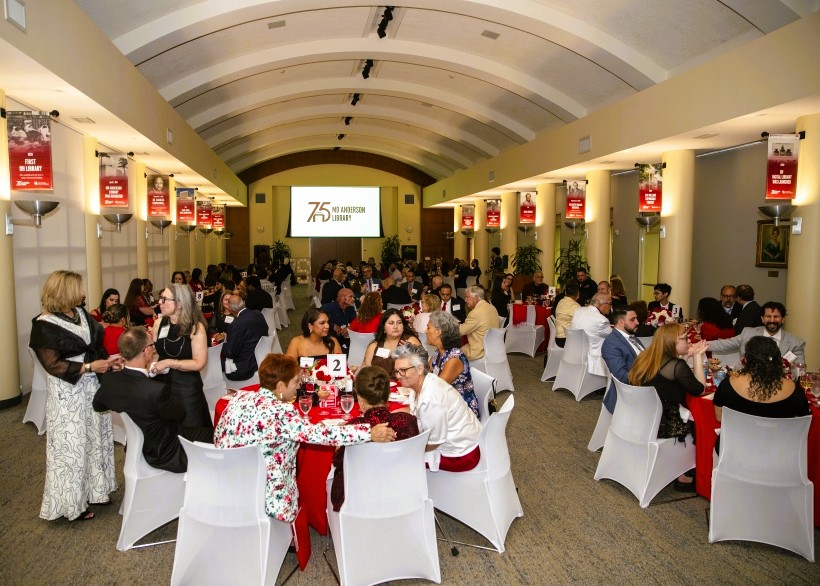
Guests were treated to a unique, crafted Library experience, one shaped by discovery and curiosity. The event featured themed vignettes:
- History of the MD Anderson Library
- Abundant Stacks, Quiet Study: The Library of the Past
- Fueling New Forms of Scholarship: The Library in Today’s Digital Age
- Beyond the Stacks: The Library of the Future
- Enduring Collections: Preserving Memory Across Time
Positioned with intention at selected locations within the Library and brought to life by librarians and archivists, each vignette illuminated a chapter in the Library’s history and its evolution alongside that of the University. The story was told through archival photos, documents, and artifacts of yore including a card catalog and an iconic, midcentury Swan chair that UH alumni can recall from their days studying in the Library.
A VIP experience in the Special Collections Reading Room offered guests an up-close look at rare and ancient records of human history, including a Sumerian clay tablet; a Torah from the historical regions of Bohemia and Moravia (now part of the Czech Republic); a 1769 edition of Experiments and Observations on Electricity by Benjamin Franklin gifted to UH Libraries by the UH Cullen College of Engineering; an 18th-century Ethiopian manuscript of religious texts; a volume of hand-colored woodcuts by artist Bingzhen Yao from the 18th or 19th century; a Qur’an manuscript leaf from the 11th century; and the 1773 Poems on Various Subjects Religious and Moral by Phillis Wheatley, the first published book of poetry by a Black author in the United States.
At the conclusion of the self-guided exploration, dean of UH Libraries Christina H. Gola gave welcoming remarks. David Bertman, professor in the department of Music, served as the evening’s spirited emcee. Guests enjoyed a three-course dinner in the Elizabeth D. Rockwell Pavilion, accompanied by a graceful performance from Moores School of Music harpist Juliana Jordan. A delightful keynote from UH alum Shane McAuliffe (’03), host of The Texas Bucket List, brought a fitting finale to the evening.
Beyond a joyous, nostalgic gathering of UH alumni, friends, and colleagues, the event held a higher purpose: to inspire support for the Reimagined Library, a big idea that drives the development of modern, vibrant, and inspiring spaces and services designed to meet the dynamic needs of UH students, faculty, and scholars. Our bold, ambitious master plan will preserve traditional library spaces to honor the history of MD Anderson Library and our University, and it will transform static spaces into active, collaborative areas that reflect the way students learn today.
UH Libraries warmly thanks the host committee members, our guests, Shasta and Sasha, alumni, supporters, colleagues, and UH Ambassadors for a wonderfully memorable evening. Special recognition goes to UH alumna Cathy Coers Frank (’80), whose invaluable knowledge and connections made the event a success.
Learn more about UH Libraries giving opportunities
Watch MD Anderson Library, Reimagined on YouTube
View photos from the 75th Anniversary Celebration on Facebook
Digital Humanities Core Opens Fall Workshops Registration

The Digital Humanities Core (DHC) is now accepting applications for its Fall Workshop series. Open to all University of Houston faculty, librarians, and staff, the synchronous online workshops cover practical skills and tools for digital humanities research and projects.
Fall workshops include:
- Utilizing CollectionBuilder – September 8, 2026
- Data Aggregation for ArcGIS – September 15 & 22, 2026
- Textual Encoding Initiative (TEI) – October 6, 13 & 20, 2026
- Introduction to Omeka – October 29, 2026
All sessions take place from 10 – 11:30 a.m. CST via Microsoft Teams.
Participants who complete any workshop session receive year-long access to DHC resources, training, and programming. For more information, contact [email protected].
Hamill Foundation Multimedia Studio Relaunch
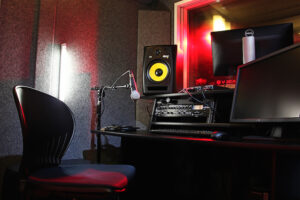
The UH Libraries Hamill Foundation Multimedia Studio is reopening its doors and is ready to help University of Houston students, staff, faculty, and other library patrons bring their audio and multimedia projects to life! Whether you’re recording, creating, or experimenting with multimedia, the studio provides a dedicated space and resources to support your work.
Book Your Studio Time
Reservations open August 23! Studio time must be reserved in advance through the reservation tool. Walk-ins are not available.
Reservations are automatically confirmed upon booking and are limited to three 2-hour sessions per week, per user.
Studio Hours
Monday – Friday, 10 a.m. – 4 p.m.
What to Know Before You Book
As we continue making improvements to the studio space, we encourage patrons to wear breezy, comfortable clothing when using the Hamill.
After your session, your files will be delivered to you via email from [email protected]. Please allow up to one business week to receive your files.
Help Us Spread the Word!
If you’re a UH Library community member, part of a college or department, or simply interested in multimedia at UH, we’d love to partner with you to showcase the studio and the work happening inside it.
Ready to create? Reservations open August 23, 2026.
New Head of Preservation and Reformatting
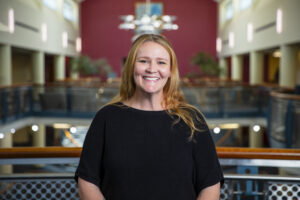
Sarah Jones is the new Head of Preservation and Reformatting at UH Libraries.
University of Houston Libraries is delighted to welcome Sarah Jones, our new Head of Preservation and Reformatting.
Please describe your role. How does your work align with the student success and research productivity focus of the University?
As Head of the Preservation and Reformatting Department (PARD) for the University of Houston Libraries, I oversee the unit responsible for preserving the libraries’ collections and ensuring materials are available many years into the future. Our department performs a variety of tasks, including reformatting audiovisual materials (VHS, film, audiocassettes, etc.) into digital files; digitizing fragile or historically valuable materials such as documents, photographs, newspapers, and scrapbooks; and even confirming that newly created born-digital materials are kept in stable and accessible formats. Our work also includes monitoring the storage environments where those materials are kept. Regular tasks include checking that spaces maintain proper temperature and humidity levels, and that the containers themselves are made of material that will not degrade or further damage the materials over time.
Preservation and digitization/reformatting work increases access to our materials for students and researchers by making them available remotely, and at the same time reduces the handling of the fragile item. The original item remains relatively stable, but the information it contains can be shared widely. PARD’s responsibilities ensure that students and researchers can access all the materials held within the library, regardless of its format, both now and well into the future.
Please share a bit about your background and professional interests. How do these inspire and shape your approach to preservation?
My undergraduate degree is in the history of science and medicine, where I first was introduced to – and fell in love with — rare books and archives. Since graduating with my MLIS, I worked in academic libraries in a variety of roles that allowed me to develop expertise across a few areas: digitization, archival processing and preservation, and reference services. All those experiences combined gave me an understanding of how central preservation is to all aspects of librarianship. Working in different areas has also given me a deep appreciation of the specialized work that our library faculty and staff do every day. It is so exciting to work with colleagues on collaborative projects and test out new, innovative ideas! Each person brings different expertise and ideas to our shared goal of connecting students and researchers with the resources they need.
What are one or two things you’d like scholars and students to know about the function/purpose of preservation and reformatting?
Preservation and reformatting balance two essential goals: protecting original materials and ensuring continued access to information for research, teaching, and learning. While my department obviously focuses on the material in the library, the same basic principles apply to your personal collection or family history. Unfortunately, most people don’t think about preservation until it is too late: the basement flooded, bugs got into clothes stored in the garage, or the cat knocked a glass of water onto your laptop before you could back up your files. Taking some small but critical steps now means your most treasured materials will last well into the future. Store your valued materials in a (relatively) dry and cool place, ideally in an enclosed container or tote, to keep pests, dirt, and water out. Keep copies of any important digital files on a couple different storage devices. If one gets destroyed, you have a backup. Preservation can be incredibly detailed and complicated, but it can also be adapted to your ability and need. Taking a few precautions now makes all the difference in 20, 30, or 100 years.
Announcing 2026 Open Education Incentive Program Award Winners

University of Houston Libraries is pleased to announce the 2026 recipient cohort of the UH Open Education Incentive (OPEN) Program.
The OPEN Program supports instructors in adopting open educational resources (OER) and open educational practices in their courses. The program’s flexibility provides a variety of options for faculty to remove costs associated with commercial textbooks, employ innovative and creative teaching methods in their courses, and share openly licensed learning materials that other instructors may reuse and adapt for their own courses. By promoting affordability of course materials and introducing experiential learning opportunities to enrich student learning, the program supports the university’s strategic goal of providing a top-tier and inclusive educational experience to all UH students.
Instructors awarded the Textbook Affordability Incentive will adopt, adapt, or create OER, or use a combination of freely available or library-licensed resources, to replace required commercial textbook(s) in a course.
Instructors awarded the Open Educational Practices Incentive will create and share an OER learning object (including assignments, quizzes, lecture slides, lesson plans, videos, or other teaching resources), which benefits both students and other educators who can reuse and repurpose it. This incentive also supports instructors in replacing a traditional assignment with a renewable assignment, implementing what is commonly called open pedagogy, or engaging students in co-creating course content that can be openly licensed and shared.
2026 OPEN Program winners are:
Textbook Affordability:
- Brandon Duke – LAW 5382: Administrative Law – UH Law Center
- Polina Kharmats – POLS 3311: Introduction to Comparative Politics – College of Liberal Arts & Social Sciences
- Julio Cesar Lopez Otero – SPAN 2307: Spanish for Heritage Learners I – College of Liberal Arts & Social Sciences
- Jovita Nsoh – CIS 6358: Secure Software Design – Cullen College of Engineering
Estimated textbook costs removed for students in the first year of implementing no-cost materials in these courses is $70,000, benefiting an estimated 400 students. Awards were granted based on the number of students impacted, cost of the textbook being replaced, the type of project and type of resources being adopted, and the feasibility of successful implementation.
Open Educational Practices:
- Carrie S. Cutler – CUIN 6341: Teaching Problem Solving in Mathematics – College of Education
- Kathrine Ginapp, Liliana Soto (Graduate Student), & Daniel Casanova – GHL 3420 & GHL 3197: Foodservice Operations & Introduction to Baking and Pastry – Conrad N. Hilton College of Global Hospitality Leadership
- Elena Farah – INTB 3355: Global Environment of Business – C.T. Bauer College of Business
- Khirul Basar Mim – GRET 6336: Global Retail Analysis of World Regions – Cullen College of Engineering
These Open Educational Practices proposals will impact approximately 350 students. Awards were granted based on project goals, feasibility of successful implementation, and anticipated enhancement to student learning.
“We are proud to continue growing the impact of the Open Education Incentive Program by expanding access to high-quality, no-cost learning materials,” said Ariana Santiago, associate dean for research and student engagement. “Through their commitment to student success, instructors are reducing barriers, fostering greater engagement, and creating meaningful learning experiences that empower students to thrive both inside and outside the classroom.”
Learn more about open educational resources at UH.
Special thanks to the members of the 2026 OPEN Program Review Committee: Kate McNally Carter, Wenli Gao, Dr. Marédil León Cedeño, Dr. Nathan Shepley, and Imani Spence.
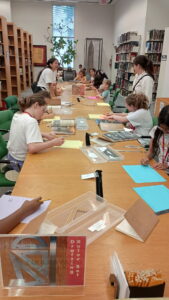
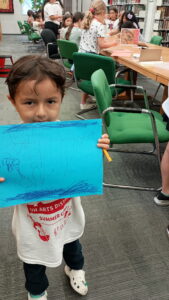
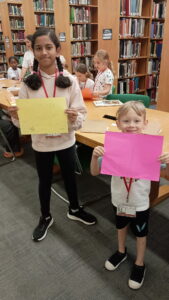
UH Arts District Summer Camp: Architecture & Design Week at the UH Architecture, Design & Art Library
This summer, the UH Architecture, Design & Art Library hosted the Architecture & Design Week of the UH Arts District Summer Camp for children ages 6-12. Through this program, campers experienced some of UH’s most vibrant artistic and design programs, including a tour of the Jenkins Library and the opportunity to design their own residential buildings. There were three workstations: in the first, campers used the library’s extensive resources to research residential building designs; second, they used the library’s design tools to create their own basic house plans; and third, they decorated their plans using a variety of arts and craft supplies. Eventually, they created their own models under the guidance of camp leaders in the Elgin Street Studios. This was a wonderful opportunity for young minds to learn both practical and creative skills. Scroll through the gallery to see photos from this fun and educational week!


Meet Shasta, the New UH Libraries Chatbot!
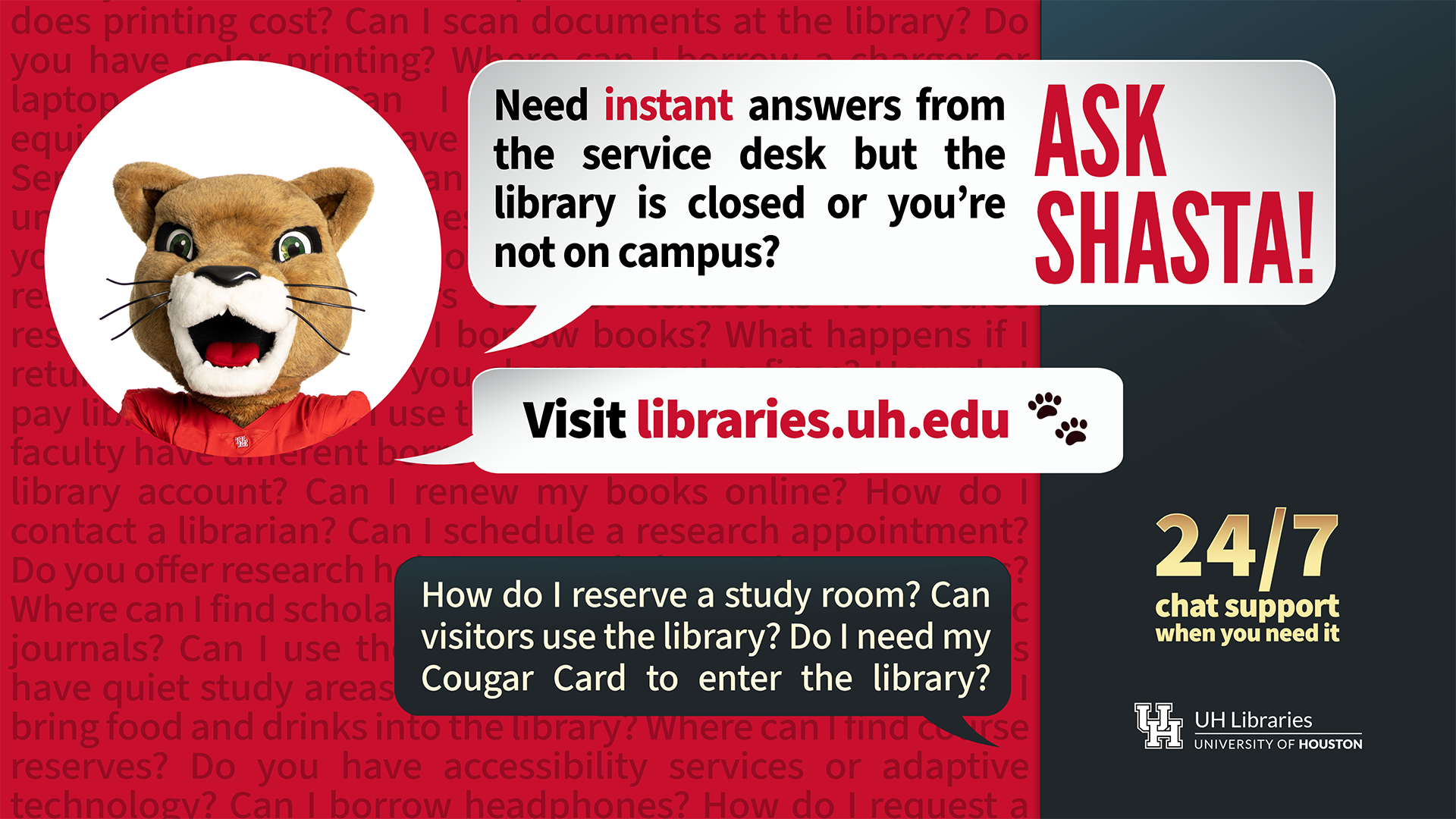
Shasta, UH Libraries’ new AI-powered chatbot, is now live on the UH Libraries homepage.
Designed to help students, faculty, and staff quickly find answers to common questions, Shasta is grounded primarily in UH Libraries’ website content and can also draw on information from across UH campus resources when needed. Whether you’re looking for library hours, borrowing information, research support, or other campus-related resources, Shasta can help you find answers without the extra searching.
Click on the image above and give Shasta a try!