Finding Dr. Drake: How Archives Helped Uncover a Family and Community Legacy
An artifact of family and local history came to life this year for historian and journalist Carlton Houston during a visit to University of Houston Libraries Special Collections. There, he was able to hold and read a 1929 document written by his grandfather, Dr. William M. Drake.
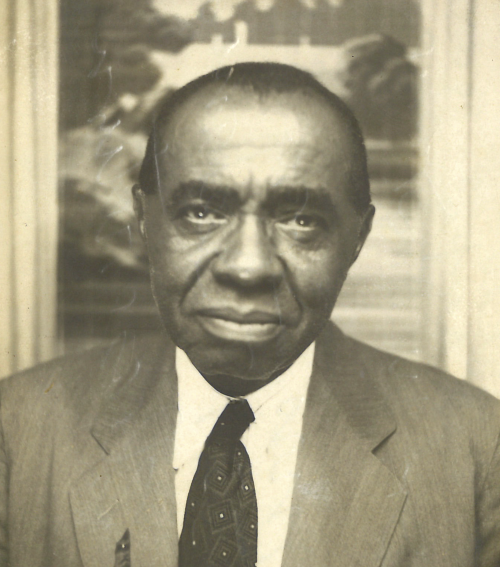
Dr. William Marcellus Drake (1870-1948). Image courtesy of Carlton Houston.
It was no ordinary letter. In it, Drake, a leading surgeon and advocate for the Black community, made a strong appeal to the benefactor of the city’s first nonprofit hospital serving Black patients. As oil magnate Joseph S. Cullinan considered transferring control of Houston Negro Hospital (later known as Riverside General), Drake maintained that he and other Black physicians were better qualified to lead and manage the institution.
The original letter was one of many archival materials that gave Houston a richer understanding of his grandfather’s career and influence, which he recounts in his 2026 book, “The Houston Negro Hospital: The Untold Legacy of Riverside General.” The work of narrative nonfiction explores the life of William Drake, who was born to formerly enslaved parents in late 19th century Mississippi and became a respected physician, educator, and civic leader. More than a biography, the book connects Drake’s stewardship of the institution to the broader story of the 20th-century Black hospital movement, one that transformed access to health care during segregation.
The research that was the foundation of the book began decades earlier as mere curiosity about Drake. Houston and other family members knew little about his earlier life and had been researching since the 1980s. Around 1990, a fortuitous connection placed them in touch with Mabel Kilpatrick, Drake’s goddaughter. At 100 years of age, she shared illuminating stories.
The conversation was a breakthrough, Houston said, that inspired more searching for facts and context. As records surfaced, Houston, who had spent 25 years in the news business as a reporter and executive, sensed that his grandfather’s story intersected with a larger historical narrative. Years passed, and then, around 2010, Houston discovered the 1929 letter Drake had written. It was part of the Joseph S. Cullinan Papers at UH Libraries Special Collections, and had been digitized and made publicly accessible.
UH Libraries Special Collections preserves and shares the stories that have shaped Houston’s history, documenting the people, institutions, and communities that have contributed to the city’s growth and character. For scholars examining institutions deeply rooted in the community, these archives provide critical context and firsthand perspectives that connect individual stories to broader historical developments.
As he went through the Cullinan digitized archival documents along with other sources like newspapers.com, Houston was able to find many records related to Drake, which he began placing in chronological order. The research revealed connections between key people, decisions, and conflicts that were not immediately obvious when viewed separately, clarifying events surrounding the hospital’s development and showing evidence that Drake was a central leader in the Black hospital movement.

Carlton Houston holds the 1929 letter written by his grandfather in the UH Libraries Special Collections Reading Room. Image courtesy of Carlton Houston.
Rather than focusing solely on institutional history, Houston sought to understand the person behind the documents. Evidence of Drake’s commitment to public service, including charitable giving during the Great Depression and leadership roles, was clear. Beyond his professional work, Drake was engaged in civic and political life, corresponding with influential figures and supporting causes that would shape American history. As treasurer of the Houston chapter of the NAACP, he exchanged letters with a young attorney named Thurgood Marshall and worked on an early political campaign for Lyndon B. Johnson, before either man rose to national prominence.
For Houston, uncovering his grandfather’s legacy was both a scholarly pursuit and a personal journey. The question at the heart of the research: Who was this man?
He believes that same sense of curiosity can inspire students and first-time researchers. Houston encourages those new to archival research to start with their own question. A newspaper article, photograph, advertisement, or handwritten letter can spark an unexpected line of inquiry, he said. Small discoveries often lead to new insights and a richer understanding of the past.
Houston’s experience underscores the importance of preservation and access to historical materials. He credits Special Collections archivists for recognizing the value of the materials and ensuring they were made available online. Of the 1929 letter, he said: “I’m holding this piece of paper today because [Special Collections] had the wherewithal to say this is important and we’re going to make it accessible.”
Houston’s book is available for research in the Special Collections Reading Room. Visitors may schedule an appointment.
Riverside General Hospital in Houston’s Third Ward celebrated its 100th anniversary on June 19, 2026.