Open Education Services Collaborates with two faculty members to receive Open Pedagogy Certification
Two faculty members collaborated with the UH Libraries Open Education Services department to complete the Certificate in Open Pedagogy program offered by the Open Education Network (OEN).
The Certificate in Open Pedagogy is a guided, team-based professional development program designed to help a faculty member and a faculty partner (either a librarian or instructional designer) to learn more about open pedagogy, a teaching approach that engages students in co-creation of open educational resources (OER).
The year-long program began in the early spring with a 9-week online course in which participants reviewed readings and videos, engaged with discussion prompts, and created a personalized action plan. This action plan becomes a customized map for how the faculty member, with the partner’s support, will implement an impactful open pedagogy project within a course in the following fall semester. The coursework phase concluded with a Project Symposium, where participants shared their action plans with other members of the cohort to showcase their work and gather feedback.
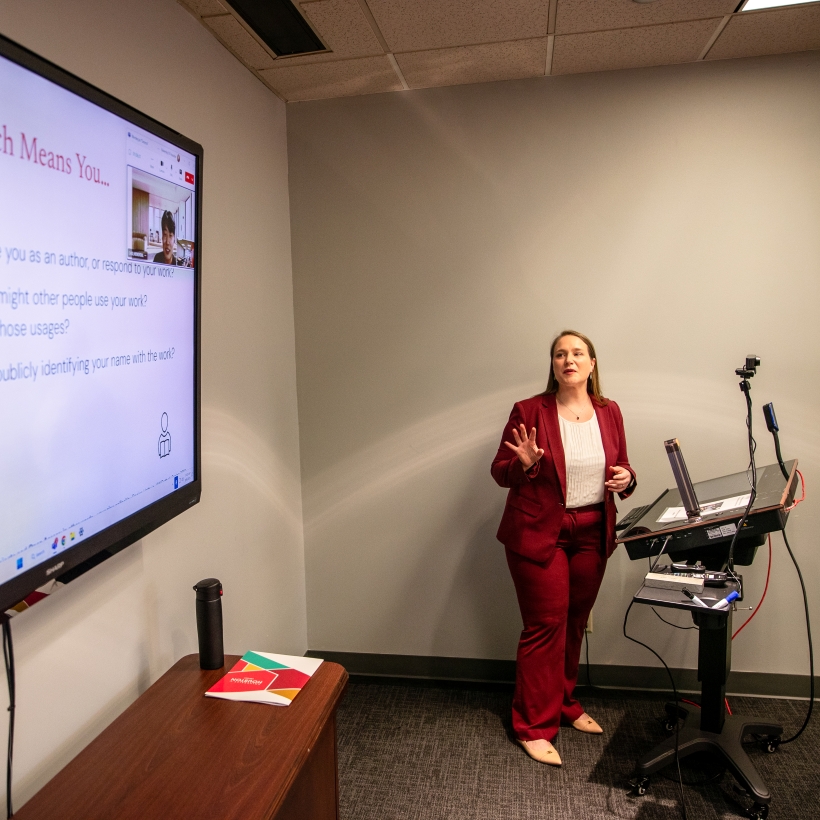
Open education librarian Kate McNally Carter instructs on creative commons licensing to the students in Dr. DeFranco’s Teaching Methods in Hospitality Administration course.
Kate McNally Carter, Open Education Librarian, partnered with Dr. Agnes DeFranco (Professor, Conrad N. Hilton Distinguished Chair, Conrad N. Hilton College of Global Hospitality Leadership) and Dr. Emese Felvégi (Executive Director of Digital Learning and Senior Professor of Practice, C.T. Bauer College of Business) to complete the online program, and are continuing their collaboration into the fall semester with two open pedagogy projects.
Dr. DeFranco and Dr. Felvégi each co-developed an Action Plan with Carter for one of their respective courses, focusing on transforming an existing course assignment into an opportunity for students to create valuable teaching and learning resources that they could elect to publish openly. Inviting students to share their work benefits other students who may be able to learn from, and in some cases build upon, those resources, creating enduring impacts for student learning.
Dr. DeFranco chose to adapt an assignment for her doctoral Teaching Methods in Hospitality Administration course. Previously, students analyzed the educational philosophy of a prominent scholar, drafted their own teaching philosophy, and then compared their philosophy with the selected scholar. In the transformed assignment, students are encouraged to develop a formal presentation with a variety of media and publish this along with their written educational philosophy. DeFranco piloted her action plan over the summer and is formally launching it with her students in the fall.
“Student success is the goal of any educator, regardless of discipline,” DeFranco says. “It is important for an aspiring professor to find their own philosophy by studying those of prominent education influencers and then share it with their students. This builds trust in the learning environment and provides reflective opportunities for them to continuously adapt and align their teaching to new knowledge and challenges.
“To be able to share their philosophies openly,” DeFranco continues, “the PhD students can further hone their pedagogical choices and receive feedback from a wide educational community of scholars. It is very heartwarming to see how much time and thought that they put in for this exercise in our class.”
Dr. Felvégi leveraged the certificate program to further her knowledge of open pedagogy, having used the teaching approach in previous courses through the UH Libraries’ Open Education Incentive (OPEN) Program. For this certificate, her action plan focused on refining an existing open pedagogy assignment in her undergraduate Business Computer Applications course. Felvégi has assigned students in her Honors course to develop learning modules and ancillary materials based on existing OER. Students were invited to engage with a variety of media to develop a wide range of learning materials that could be used in future courses.
“The perspectives of our students on contemporary business topics or practices combined with their creative approach to the ancillaries in Canvas and Pressbooks have been terrific for me to observe and learn from,” Felvégi says. “For the student groups, their ability to pool their own educational experiences and create something new with or about generative AI held useful lessons on collaborations not only among peers, but also between humans and machines.”
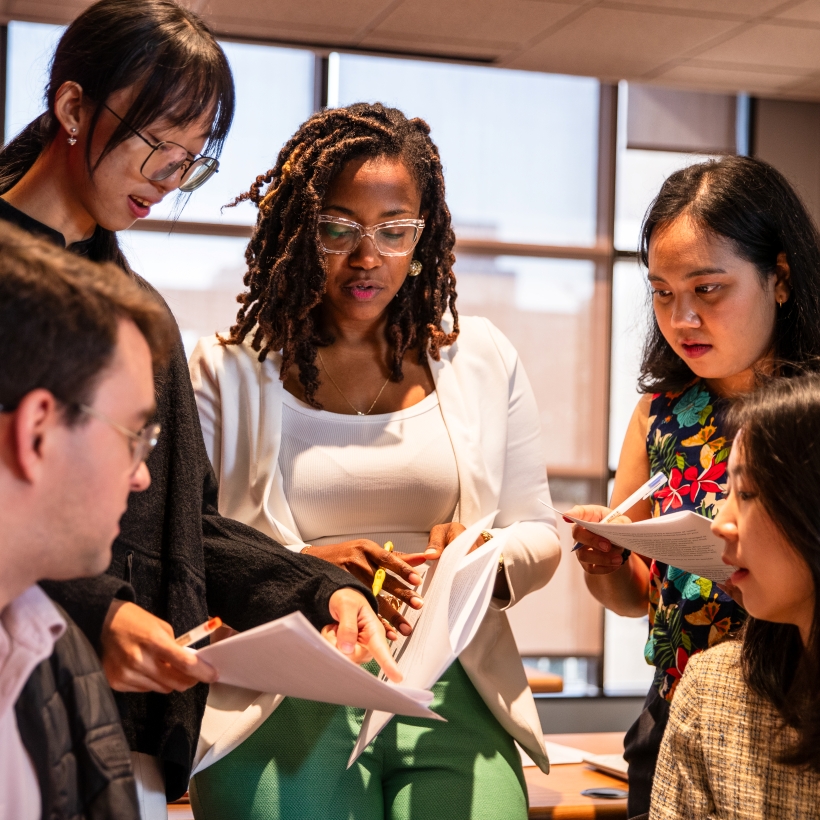
Students in Dr. DeFranco’s course
During the coursework portion of the program, Carter, DeFranco, and Felvégi met weekly to discuss the curriculum, the assignments for the week, and the two action plans, forming an informal learning community around the program and supporting each other by discussing how they could improve upon their open pedagogy assignments.
“Having both instructors from different colleges with different perspectives really enhanced the professional development experience for all of us,” Carter noted. “We were able to learn from each other, especially at the beginning when brainstorming initial ideas for the action plans and how the assignments would be redesigned. The Certificate curriculum was helpful in not only introducing the essential concepts behind effective implementation of open pedagogy, but also equipping instructors with necessary tools to get started with it.”
DeFranco noted her appreciation for the Certificate curriculum and how it has impacted her teaching. “Participating in the program allows me to gain a better understanding of open pedagogy and open educational resources,” she says. “This is now an integral topic of my class.”
This fall, the high-enrollment mass sections of the Business Computer Applications course are learning with student-created materials from a previous semester, using them as engaging low-stakes formative assessments. Current students are learning from the experiences of seniors who weaved their own learning journeys into their modules to encourage current students to follow in their footsteps. These lessons put a spin on traditional textbook content and make them relevant and more personal.
“It has been a great experience working with Agnes and Emese’s classes this fall,” Carter added. “The students have been engaged and interested in the opportunity that open publishing provides. After a class is over, it’s gratifying to be able to showcase something you worked hard on and know that it’s benefitting others, and open pedagogy has an opportunity to give students that experience.”
The option to publish their work openly gives students an opportunity for their work to have a purpose beyond coursework. As DeFranco puts it, “By sharing with others, the project becomes more real. It is now not just a class project, but it is their own professional identity. This work is not for me nor for a grade, but it is for them, and for their future students.”
To learn more about teaching with open pedagogy, contact Open Education Services by emailing [email protected].