Sculptures by Marla Gallardo: Community, Color, Books, and Joy
The Jenkins Library is pleased to announce an exhibition featuring the work of undergraduate UH Sculpture student Marla Gallardo!

Marla Gallardo, Mar’s Planets, 2026
In Marla’s words:
“As a sculptor, I create installations that encourage interaction, curiosity, and shared experience, using color and decoration to create spaces where connection and joy can emerge. After the pandemic, my perspective on community changed. Spending time with others making art, talking, sharing, or simply existing together became a sacred act, and this sense of togetherness continues to guide my work.
As a young Hispanic woman with immigrant parents, I navigate the feeling of being seen but not fully understood. This shows up in my practice through my desire to create environments where people can connect without needing to explain themselves. Instead of focusing on difference, I build spaces where shared presence is enough.
I am interested in making others happy, and in turn making myself happy. My work explores color, repetition, and interactive environments, treating decoration as a serious artistic language. I use high-dopamine colors, vibrant hues that create an immediate emotional pull and sense of energy.
Displayed in the library, the piece exists alongside books and shared knowledge, reinforcing my belief that art and learning are collective experiences.”


-

- Details, “Mar’s Planets”

Marla has also curated a book display for the library, focusing on women sculptors.
“This book display is an extension of my sculptural practice, bringing together research and history that informs the mark-making choices I make today. Looking closely at female artists helps me understand where I’m coming from and how my work fits into a larger lineage. I am especially drawn to Louise Bourgeois and Yayoi Kusama. Bourgeois’s view on womanhood and self-expression, along with her constant and repetitive way of working, really resonates with me. I often think about her large ‘mama spider’ sculptures. Kusama’s use of repetition through dots and her “obliteration rooms”, which are designed to be changed through interaction, also influences how I think about space and participation.

Marla’s book display in the Jenkins Art, Architecture and Design Library. All titles are available for checkout.
“These books act as tools, but also as something more. The ability to check out up to 99 books from the architecture library feels like a kind of abundance, a way of holding and gathering knowledge. As students, we are able to surround ourselves with information about art in a way that feels almost excessive, but also really inspiring. I created an interactive installation called Craft Party that explored this connection between art and knowledge, and this display continues that idea.
-

- A wagon full of books from the Jenkins Library

-

- Books featured at “Craft Party”
-

- “Craft Party,” October 2025
“There is something to learn from these artists, but what that is changes depending on the
person. Even just looking through the images can be enough to spark something.”
Marla’s work will be on display through April 24.

Marla even made some sculptures for the bookcase.
Gropius’ Vision: Books on the Bauhaus School from the Kenneth Franzheim Rare Books Collection
Now on view in the Jenkins Library of Architecture, Design and Art:

Bauhaus students, 1927


Envisioned by Walter Gropius, the Bauhaus was a school where architecture, art, graphic and industrial design, weaving and even technical theater coexisted and influenced each other.
Beginning in 1919 in Weimar, Germany, then relocated to Dessau, the Bauhaus is known for (and in some cases even invented) many aspects of the contemporary visual landscape as we know it today. In architecture, Bauhaus pioneered “glass curtained” buildings, mass prefabricated housing using iron-enforced concrete, and the minimalist concept of form over decorative elements. Some other contributions of the Bauhaus include metal tubing in chair design, auditoriums with folding seats, cellophane, combination teapot, and lighting tubes, to name just a few.


Gropius rejected the nineteenth century idea of the artist as an isolated genius. He believed an artist was just a craftsperson that got lucky sometimes and created art with a spiritual aspect, but that everyday useful craft was vital to society. He felt that all artists should be skilled in a useful craft, and with it, be able to earn a decent living. A believer in the creative power of the group, he urged architects to work holistically with urban designers and craftspeople. As a passionate advocate for democracy of thought, education was a huge part of Gropius’ career, and he urged the teaching of visual thinking as early as kindergarten, so that the general populace could contribute their opinions to the arts of their environment in a meaningful way. Because the arts, and thus beauty, could move people to call forth ethical powers, he believed that good architecture, art, and design were vital to modern society.
Bauhaus flourished until 1933, when the Nazis closed the school. Many Bauhaus masters emigrated to the US, teaching and spreading their ideas, which continued to heavily influence 20th century modernism further afield.
This exhibition was curated by Jenkins Library Supervisor Brooke Bailey and is on display on the first floor of the library.

The Jenkins Library invites students to display their artwork in the library
In the William R. Jenkins Architecture, Design, and Art Library, the visual art is not just inside the pages of the books. It’s on the walls and in the public spaces. In addition to a permanent exhibit of prints by MANUAL (Edward Hill and Suzanne Bloom), which is part of the University of Houston System’s Public Art collection, the library proudly displays the artwork of UH students throughout the year.
Students wishing to display their work in this public venue on campus should submit an application soon. We are now considering work to show in the spring, summer, and fall semesters.
UH Undergrad Curates a Book Display for the Jenkins Library
What Comes After Truth?
Books on Post-Documentary Photography
Curated by UH Photo | Video student Josh Peterson

Undergrad Joshua Peterson is one of our biggest library patrons. Library Supervisor Brooke Bailey says, “Josh always checks out the most interesting books. I love photography, so I would ask him about the books, and he always elucidated with such interesting insight and enthusiasm. I joked, ‘you should curate a book display for us.'”
Josh was geniunely interested in the idea, and Jenkins Head Librarian Catherine Essinger gave him the go-ahead. Josh not only handpicked each book on display, but he suggested new monographs for the library to purchase. Because of his expertise, the Jenkins Library now has two new acquisitions, Knit Club and The Adventures of Guille and Belinda.

The Adventures of Guille and Belinda, by Alessandra Sanguinetti
Josh writes:
“Post-documentary photography emerged in the late twentieth century as photographers began to question the assumptions and authority of a documentary practice. Traditional documentary photography is similar to photojournalism in its pursuits to inform, persuade, or advocate, often presenting images as transparent records of reality. In contrast to that, post-documentary work emphasizes uncertainty, subjectivity, and critical reflection. Rather than claiming to show the world “as it is,” post-documentary projects acknowledge that every photograph is shaped by choices: where to stand, when to press the shutter, what to exclude, and how images are sequenced or contextualized. In this sense, the photograph is not treated as evidence alone, but as a reflection of the photographer’s intentions and relationship to the subject.

Knit Club, by Carolyn Drake
Post-documentary projects often incorporate text, archival materials, staged elements, personal narrative, or conceptual strategies alongside photographic images. Traces of events and seemingly banal details are frequently used to suggest social realities indirectly, inviting viewers to read between images rather than rely on a single, authoritative account. As the post-documentary genre developed, the photobook emerged as one of its most prominent vessels for articulation and circulation. Unlike single images or exhibition displays, books allow a body of work to be reflected upon over time and shared in a democratic fashion through libraries and personal collections.
This display is comprised of a collection of photobooks from the past 18 years that represent all the messiness of contemporary documentary photography. Even though the post-documentary tradition has largely been focused in and around the United States, I tried to give a global perspective with this display. Some of them are almost entirely staged, some of them could be considered
photojournalism, but all of them contain photographs taken from the world and reckon with photography as an indexical artifact.”


Thank you for sharing your knowledge and passion, Josh!
*All books in this display are available to be checked out.
Walk the Walk: Immigration and the Dispossessed in the Work of Robert Campbell and Paul Turounet, now on view in the Jenkins Library
Photographer Paul Turounet and artist-physician Robert Campbell shared a fascination with Latin America. Empathy with the dispossessed led them on journeys there, Turounet to the Arizona-Mexican border to experience the migrant path and photograph fragments of their stories; Dr. Campbell to Guatemala, where he operated free clinics providing basic medical care. Both artists’ work comes out of, and is inseparable from, their humanitarian paths.
The words Elizabeth McBride wrote about Robert Campbell could easily be said of both artists:
“He was an artist who involved social activism in his art, yet without protest, rather with humility and sincerity.”

Paul Turounet, Estamos Buscando A, 2017
Bajo La Luna Verde (Under the Green Moon)
Photobook, prints, self-published 2014
Paul Turounet
In 2004, Turounet travelled to the US-Mexican Border in Arizona to walk twelve-miles of dirt road south of Sasabe. Intending to photograph migrants, his journey turned out to be one of extreme solitude due to the danger of the journey. Skirting smugglers and navigating the treacherous conditions of the Sonora Desert, Turounet’s photographs are interspersed with prose describing his journey of a day and a night, marked by rhythmic repetitions: taking a sip of precious water; the experience of the violent daytime heat and nighttime cold.
Of the night spent sleeping in some brush, Turounet said “I have never felt so alone… I just wanted to go home.”

Paul Turounet, Bajo La Luna Verde, 2014
Estamos Buscando A (We are looking for)
Photobook, prints, self-published 2017
Paul Turounet
Later in 2004, Turounet returned to the border/ Sonora Desert, this time in the company of Grupos Beta, a Mexican organization that advises migrants and registers minors attempting to cross.
Traveling by truck through the desert, they passed points known by migrants and “coyotes” (human smugglers): “La Ladrilla” (the Brickyard), where migrants congregate to make travel plans and find a coyote to take them across; and Arroyo de Coyote, a pit filled with discarded clothes and other possessions, where migrants are robbed and the women raped. The journey ended at Rancho La Sierrita, another point for pickup and smuggling.
Turounet’s photographs document these places, and the migrants he met along the way.

Paul Turounet, Bajo La Luna Verde, 2014

Paul Turounet, Estamos Buscando A, 2017
Tierra del Vida
Robert Campbell
Exhibition Catalog, Diverseworks, Houston, TX
December 10, 1994- January 29, 1995
Born in 1955, in Claude, TX, Robert Campbell was a neurologist with a medical degree from Baylor. He was also an artist entranced by the beauty of colors and textures, and a Catholic inspired by the Latin American church’s “liberation theology” teaching on living a simple life and helping the poor.
“Art feeds into medicine and medicine feeds into art. Art should be socially responsible and it is a part of the healing process. Medicine is more technical, and having lost a lot of its humanity, regains it through art,” Campbell said.
Dr. Campbell founded the Sociedad San Martin de Porres, a network of free clinics in Belize and then Guatemala. All proceeds from his art went to fund these clinics, and many artist friends were volunteers.
Campbell was inspired by the people he met in Guatemala and the Mayan/Catholic rituals he experienced there. His work involved fragile materials that changed over time: dried flowers, fabric soaked in plaster, and candle wax. He wanted to expand art to the point that it could hold the deep spiritual aspirations and empathies of people.
This exhibition catalog features work that took shape in the now-defunct Commerce Street Studios in Houston and were exhibited at Diverseworks before Campbell’s death from AIDS in 1995 at the age of 39.
This exhibition was curated by Jenkins Library Supervisor Brooke Bailey.

Robert Campbell, Pan de Vida, 1992 and Homenaje a San Juan de la Cruz, 1990

Robert Campbell, Feast Day of San Martin de Porres, Mass and Daily Novenas. Partial view of installation, November, 1989.
Exhibition catalogue on black American artists in the 1970’s added to the Kenneth Franzheim II Rare Book Room collection

The latest acquisition in the Kenneth Franzheim II Rare Book Room is Jubilee: Afro-American Artists on Afro-America, which documents a Museum of Fine Arts, Boston exhibit mounted during the nation’s bicentennial celebrations. The author states, “Jubilee…sought to capture the flavor of black life in America through art, introducing its bittersweet dimensions, its joys and tragedies, and more than anything else, introducing its triumphant spirit and its fathomless creativity.” Artists as diverse as Romare Bearden, Camille Billops, Barkley Hendricks, Archibald Motley, Faith Ringgold, and Charles Searles interpret 20th century black life in figurative work with themes “taken from blues and jazz lyrics, and black poetry.”
Patrons may contact the William R. Jenkins Library staff at [email protected] to schedule a viewing.
[Pictured above: Wrapping it up at the LaFayette by Romare Bearden. ]
An Open Call for Art Submissions on Campus
Healing Through Art
An Open Call for Art Submissions
Celebrate the role of art in supporting health and wellness by providing a platform for community artists to share their vision of healing, while enhancing our clinic spaces with works that bring peace, reflection, and encouragement to those we serve.
UH Health Family Care Center invites students, staff, and faculty to submit original photos and digital art for display within our clinic. Celebrate the role of art in supporting health and wellness by providing a platform for community artists to share their vision of healing, while enhancing our clinic spaces with works that bring peace, reflection, and encouragement to those we serve.
See UH Health Family Care Center for more information.
New Student Art Exhibit at the Jenkins Architecture, Design and Art Library
The Jenkins Architecture, Design and Art Libraries invite you to come take a look at our latest Student Art Exhibit, on view until November 30, 2025.
Artist Bio
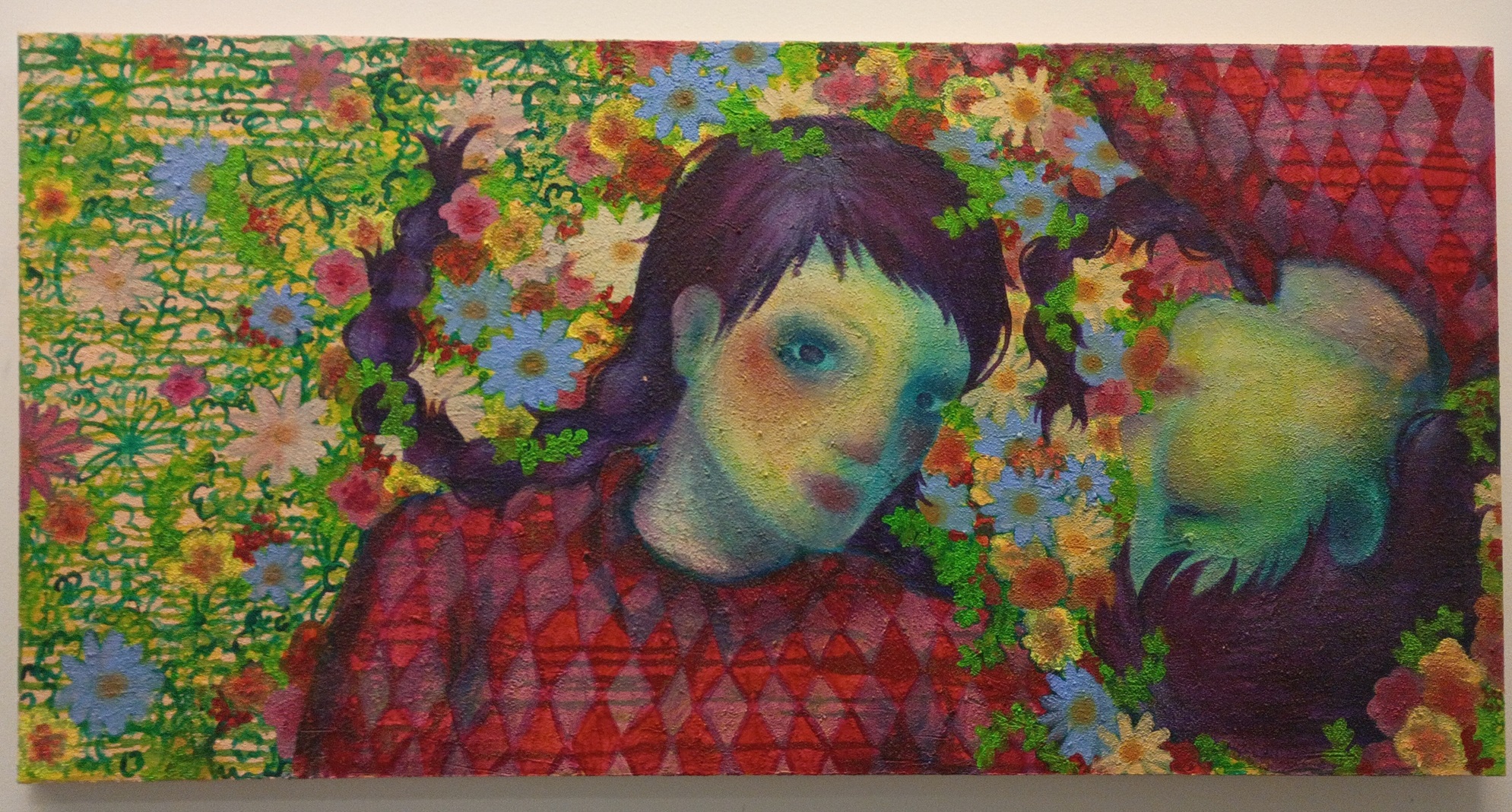
Mena Massey is a Senior currently pursuing a Painting BFA at UH. Mena works with mixed media to create figurative dreamscapes that depict scenes from memory and fantasy. Often within her practice Mena is working in themes of yearning and remembrance. Trying to capture fleeting moments that feel symbolic and foretelling. Primarily working with acrylic paint, she also creates textural grounds from sand, paper and cardboard that allow her to experiment with different surfaces and color fields for her subject matter to live within. For her dreamscapes, it’s important to her narrative that these compositions have a busy ground to work off of, allowing deeper atmospheric space to house these fantasies.
Artist Statement
Mena Massey’s paintings live within moments of what once was and what can never be. She balances themes from memory and fantasy to capture moments of yearning and fear. There always seems to be a precipice of momentum frozen within her paintings that makes the viewer wonder what comes next. Mena relies heavily on texture to push these narratives, either allowing it to guide her subject matter or present another layer of depth within the works. These dreamscapes developed from a need of understanding her emotions and making sense of dramatic nightmares, questioning whether it was a warning or memory. Omens of fantasies beckoning comprehension. For what will become a reality and what will stay imagined.
(Any and all students, both Graduate and Undergraduate, are welcome to submit art for exhibition at The Jenkins Architecture, Design and Art Library. Submittal information and form are available here.)
Book event: The Architecture of Texas Art Museums
Books & Bytes is a series of talks about the research, writing, and publishing of art and design books by local authors. Co-hosted by the Gerald D. Hines College of Architecture and Design and the William R. Jenkins Architecture, Design, Art Library, Books & Bytes provides a platform for our community of scholars to learn from one another’s experience sharing their research and artistic output.
We are pleased to welcome Ronnie Self, author of The Architecture of Art Museums: a Decade of Design, 2000-2010, to talk about his forthcoming monograph The Architecture of Texas Art Museums at 5 pm on October 16th in the library’s upper mezzanine.
Andy Warhol Books from the Kenneth Franzheim II Rare Books Room
ON VIEW NOW
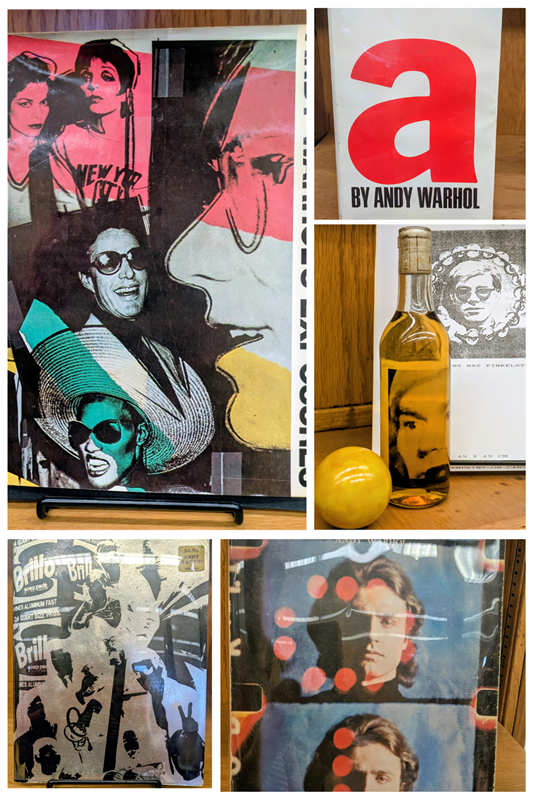
Andy Warhol left a vast body of work that spread from commercial art and silkscreen prints into films, happenings, fashion… and also books. Some of these books were more critically successful than others, but all of them offered a fresh and even subversive vision of what the medium of a book could be.
Perhaps the most well-known of Warhol’s books, Index (also known colloquially as ‘the Andy Warhol pop-up book’) features high-contrast black and white photographs and experimental pop-up features of the superstars and factory lifestyle. Much harder to find now is Screen Test, which pairs excerpts from Gerard Malanga’s daily poetry diary with stills from the early Warhol films. a, A novel is Warhol’s take on the novel: haphazard transcripts of a tape recording, done over a few speed-fueled days in the life of Factory superstar Ondine. And as Warhol moved into the Disco era with a camera always in hand, he snapped the new celebrity culture at Studio 54 and published Andy Warhol’s Exposures.
A commemorative “Warhol goody box” issued in 1992 deconstructs the concept of “book” further, with a huge catalog of Warhol happenings, products, exhibits and art issued in loose xeroxed pages instead of bound. A mirror silkscreened with Nico’s face, a yellow rubber ball, and a bottle of what appears to be Greek Wine add to the pop cacophony.
This display was curated by Jenkins Library Supervisor Brooke Bailey.