New Open Textbook Available: A Journey Through eLearning Design
A faculty member in the University of Houston Cullen College of Engineering recently published a new open educational resource (OER) with the support of UH Libraries Open Education Services.
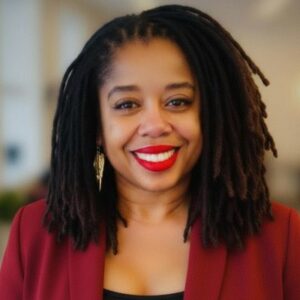
Dr. Tasha Bennett
Dr. Tasha Bennett, Lecturer in Human Development and Consumer Sciences, participated in the OER Creation Program with UH Libraries, an incentive program that supported faculty in developing high-quality course materials that are free to access, share, and customize. The program provided professional development and financial support for faculty to develop new OER that would be used as required course material in a UH course or program, and that would fill a gap in existing OER content.
Bennett successfully completed a year-long professional development program facilitated by the Rebus Foundation, which provided training for OER project scoping, content creation, review, and editing. After completing the program, Bennett developed and organized the content for the book, then formatted and published the completed OER on Pressbooks, a publishing platform provided by UH Libraries for open course materials.
Reflecting on her experience, Bennett noted that the structure and support provided helped her move the open textbook project from concept to completion. “It not only supports the development of high-quality open textbooks but also empowers faculty to rethink how learning resources can be designed to better serve our students,” Bennett said.
The open textbook, A Journey Through eLearning Design: From Idea to Impact, was published on UH Libraries Pressbooks in December 2025. It was designed to support two undergraduate Human Resources Development courses, Instructional Design for Human Resources Development and Designing eLearning Applications, both required for students majoring in the program.
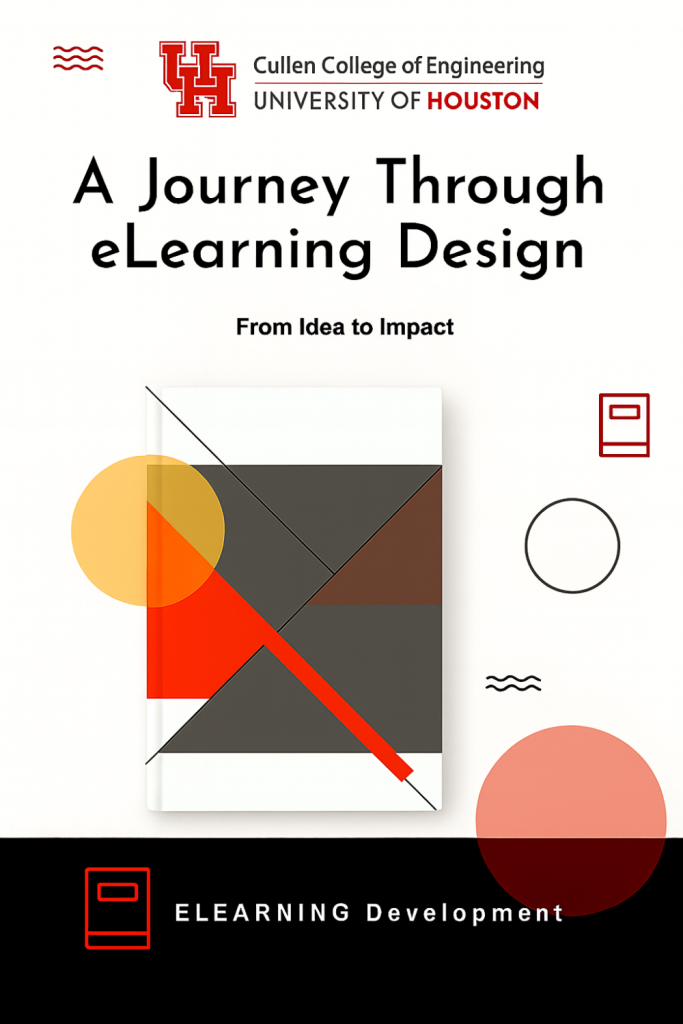
A Journey Through eLearning Design: From Idea to Impact
The textbook equips emerging creators with skills and strategies to design digital learning experiences that will engage learners in modern classroom settings. Covering a variety of foundational topics like learning design models and dimensions of learner engagement, in addition to emerging technologies like AI, the book will help students understand how they can design learning experiences intentionally to maximize their impact.
The resource is available under a Creative Commons Attribution-ShareAlike license, allowing other instructors to reuse, adapt, and redistribute customized versions that meet their specific teaching and learning needs.
“This OER will have a huge impact on the students who will be using it, not only because it’s free of cost, but it is a unique, custom resource that is tailored to Dr. Bennett’s courses,” said Kate McNally Carter, Coordinator of Open Education Services. “I am excited to see how she will be able to build upon this resource as she continues to teach with it. Additionally, it will also benefit the broader OER community by serving as an exceptional resource for instructional design education.”
In addition to structure and support, the OER Creation Program offered flexibility and emphasized faculty ownership and agency over the materials they were developing. “I appreciated the autonomy of designing a resource that aligned closely with my teaching philosophy and the specific needs of my students,” Bennett said. This enabled Bennett to center the OER around her curriculum, providing targeted training for in-demand skills that will better prepare UH students for the training and development industry.
To learn more about creating OER, contact Open Education Services by emailing [email protected].
Call for Applications: Open Education Incentive Program
University of Houston Libraries is now accepting applications for the Open Education Incentive (OPEN) Program. The OPEN Program includes a variety of funding opportunities to support engagement with open educational resources (OER) and open educational practices.
Instructors can apply for the following award categories:
- Textbook Affordability Incentive: Instructors can receive funds to replace a required commercial textbook in their course(s) with OER and/or no-cost alternative resources, such as library licensed or freely available resources. Awards in this category range from $1,000 to $5,000.
- Open Educational Practices Incentive: Instructors can receive funds for: 1) creating openly licensed learning objects, 2) replacing a traditional assignment with a renewable assignment, or 3) some combination of the above. Awards in this category range from $500 to $2,000.
OER are teaching and learning resources that are in the public domain or have been licensed in such a way that allows anyone to freely use, modify, and re-purpose them. Open educational practices leverage OER to enhance student learning, and include the creation, use, and reuse of OER, and open pedagogical practices, such as renewable assignments.
The deadline to apply is Friday, March 6, 2026. Interested applicants are encouraged to attend an information session on February 11 to learn about the incentive program and the benefits of open education.
Faculty and instructors may also make an appointment with Open Education Services to discuss implementing OER and the support provided through the incentive program.
Open Education Services Collaborates with two faculty members to receive Open Pedagogy Certification
Two faculty members collaborated with the UH Libraries Open Education Services department to complete the Certificate in Open Pedagogy program offered by the Open Education Network (OEN).
The Certificate in Open Pedagogy is a guided, team-based professional development program designed to help a faculty member and a faculty partner (either a librarian or instructional designer) to learn more about open pedagogy, a teaching approach that engages students in co-creation of open educational resources (OER).
The year-long program began in the early spring with a 9-week online course in which participants reviewed readings and videos, engaged with discussion prompts, and created a personalized action plan. This action plan becomes a customized map for how the faculty member, with the partner’s support, will implement an impactful open pedagogy project within a course in the following fall semester. The coursework phase concluded with a Project Symposium, where participants shared their action plans with other members of the cohort to showcase their work and gather feedback.
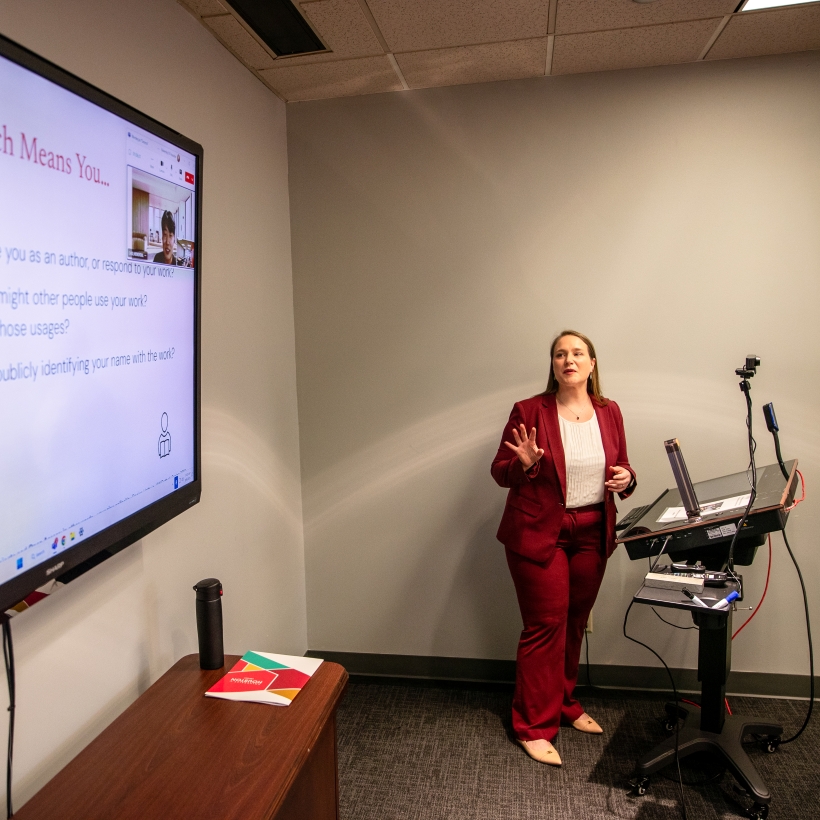
Open education librarian Kate McNally Carter instructs on creative commons licensing to the students in Dr. DeFranco’s Teaching Methods in Hospitality Administration course.
Kate McNally Carter, Open Education Librarian, partnered with Dr. Agnes DeFranco (Professor, Conrad N. Hilton Distinguished Chair, Conrad N. Hilton College of Global Hospitality Leadership) and Dr. Emese Felvégi (Executive Director of Digital Learning and Senior Professor of Practice, C.T. Bauer College of Business) to complete the online program, and are continuing their collaboration into the fall semester with two open pedagogy projects.
Dr. DeFranco and Dr. Felvégi each co-developed an Action Plan with Carter for one of their respective courses, focusing on transforming an existing course assignment into an opportunity for students to create valuable teaching and learning resources that they could elect to publish openly. Inviting students to share their work benefits other students who may be able to learn from, and in some cases build upon, those resources, creating enduring impacts for student learning.
Dr. DeFranco chose to adapt an assignment for her doctoral Teaching Methods in Hospitality Administration course. Previously, students analyzed the educational philosophy of a prominent scholar, drafted their own teaching philosophy, and then compared their philosophy with the selected scholar. In the transformed assignment, students are encouraged to develop a formal presentation with a variety of media and publish this along with their written educational philosophy. DeFranco piloted her action plan over the summer and is formally launching it with her students in the fall.
“Student success is the goal of any educator, regardless of discipline,” DeFranco says. “It is important for an aspiring professor to find their own philosophy by studying those of prominent education influencers and then share it with their students. This builds trust in the learning environment and provides reflective opportunities for them to continuously adapt and align their teaching to new knowledge and challenges.
“To be able to share their philosophies openly,” DeFranco continues, “the PhD students can further hone their pedagogical choices and receive feedback from a wide educational community of scholars. It is very heartwarming to see how much time and thought that they put in for this exercise in our class.”
Dr. Felvégi leveraged the certificate program to further her knowledge of open pedagogy, having used the teaching approach in previous courses through the UH Libraries’ Open Education Incentive (OPEN) Program. For this certificate, her action plan focused on refining an existing open pedagogy assignment in her undergraduate Business Computer Applications course. Felvégi has assigned students in her Honors course to develop learning modules and ancillary materials based on existing OER. Students were invited to engage with a variety of media to develop a wide range of learning materials that could be used in future courses.
“The perspectives of our students on contemporary business topics or practices combined with their creative approach to the ancillaries in Canvas and Pressbooks have been terrific for me to observe and learn from,” Felvégi says. “For the student groups, their ability to pool their own educational experiences and create something new with or about generative AI held useful lessons on collaborations not only among peers, but also between humans and machines.”
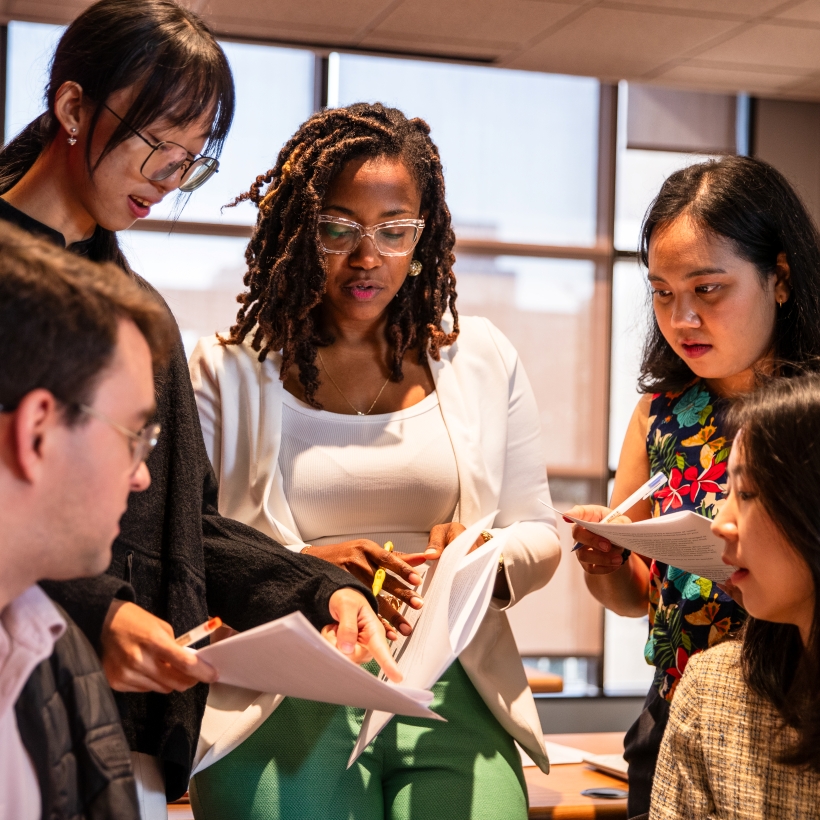
Students in Dr. DeFranco’s course
During the coursework portion of the program, Carter, DeFranco, and Felvégi met weekly to discuss the curriculum, the assignments for the week, and the two action plans, forming an informal learning community around the program and supporting each other by discussing how they could improve upon their open pedagogy assignments.
“Having both instructors from different colleges with different perspectives really enhanced the professional development experience for all of us,” Carter noted. “We were able to learn from each other, especially at the beginning when brainstorming initial ideas for the action plans and how the assignments would be redesigned. The Certificate curriculum was helpful in not only introducing the essential concepts behind effective implementation of open pedagogy, but also equipping instructors with necessary tools to get started with it.”
DeFranco noted her appreciation for the Certificate curriculum and how it has impacted her teaching. “Participating in the program allows me to gain a better understanding of open pedagogy and open educational resources,” she says. “This is now an integral topic of my class.”
This fall, the high-enrollment mass sections of the Business Computer Applications course are learning with student-created materials from a previous semester, using them as engaging low-stakes formative assessments. Current students are learning from the experiences of seniors who weaved their own learning journeys into their modules to encourage current students to follow in their footsteps. These lessons put a spin on traditional textbook content and make them relevant and more personal.
“It has been a great experience working with Agnes and Emese’s classes this fall,” Carter added. “The students have been engaged and interested in the opportunity that open publishing provides. After a class is over, it’s gratifying to be able to showcase something you worked hard on and know that it’s benefitting others, and open pedagogy has an opportunity to give students that experience.”
The option to publish their work openly gives students an opportunity for their work to have a purpose beyond coursework. As DeFranco puts it, “By sharing with others, the project becomes more real. It is now not just a class project, but it is their own professional identity. This work is not for me nor for a grade, but it is for them, and for their future students.”
To learn more about teaching with open pedagogy, contact Open Education Services by emailing [email protected].
Announcing 2025 Open Education Incentive Program Award Winners
University of Houston Libraries is pleased to announce the 2025 recipient cohort of the UH Open Education Incentive (OPEN) Program.
Formerly known as the Alternative Textbook Incentive Program, this initiative was launched in 2018 to mitigate the high cost of textbooks for students by supporting instructors in replacing commercial textbooks with open educational resources (OER). Since then, the program has expanded to include additional ways for UH faculty to engage with open education.
Instructors awarded the Textbook Affordability Incentive will adopt, adapt, or create OER, or use a combination of freely available or library-licensed resources, to replace required commercial textbook(s) in a course.
Instructors awarded the Open Educational Practices Incentive will create and share an OER learning object (including assignments, quizzes, lecture slides, lesson plans, videos, or other teaching resources), which benefits both students and other educators who can reuse and repurpose it. This incentive also supports instructors in replacing a traditional assignment with a renewable assignment, implementing what is commonly called open pedagogy, or engaging students in co-creating course content that can be openly licensed and shared.
2025 OPEN Program winners are:
Textbook Affordability:
- Layci Harrison – ATP 6113: Lower Extremity Evaluation Lab & ATP 6123: Upper Extremity Evaluation Lab – College of Liberal Arts & Social Sciences
- Dmitri Litvinov – ECE 3355: Electronics – Cullen College of Engineering
- Julio Cesar Lopez Otero – SPAN 1507: Intensive Elementary Spanish for Heritage Learners – College of Liberal Arts & Social Sciences
- Rita Sharpe – BIOL 4374/BCHS 4313: Cell Biology/Cell Biochemistry (cross-listed) – Honors College
- William Zahn – MARK 4332: Social Media Marketing – C.T. Bauer College of Business
Estimated textbook costs removed for students in the first year of implementing no-cost materials in these courses is $89,000, benefiting an estimated 500 students. Awards were granted based on the number of students impacted, cost of the textbook being replaced, the type of project and type of resources being adopted, and the feasibility of successful implementation.
Open Educational Practices:
- Laura Cizek – COMD 3371: Speech Development and Disorders – College of Liberal Arts & Social Sciences
- David Crawley – TLIM 3330: Innovation Principles – Cullen College of Engineering
- Mary Sykes and Emese Felvégi – ACCT 2301: Principles of Financial Accounting – C.T. Bauer College of Business
These proposals will impact approximately 700 students. Awards were granted based on project goals, feasibility of successful implementation, and anticipated enhancement to student learning.
Additionally, this year the OPEN Program expanded to include an OER Professional Development Incentive in which instructors completed self-paced online learning modules and received a certificate administered by the Texas Higher Education Coordinating Board. Sixteen instructors completed the OER Professional Development Incentive, including instructors from the College of Engineering, College of Natural Sciences & Mathematics, College of Liberal Arts and Social Sciences, C.T. Bauer College of Business, College of Education, Cullen College of Engineering, College of Pharmacy, Conrad N. Hilton College of Global Hospitality Leadership, and the Kathrine G. McGovern College of the Arts. The full list of all award recipients can be found on the OPEN Program webpage.
“I’m excited that we are able to continue expanding awareness of open education through the Open Education Incentive Program,” said Ariana Santiago, head of open education services and interim associate dean for research and student engagement. “Instructors are supporting student success by ensuring they have free access to course materials and developing engaging learning experiences with open pedagogy.”
Learn more about open educational resources at UH.
Special thanks to the members of the 2025 OPEN Program Review Committee: Lu Gao, Edward Gloor, Virginia Sisson, Kate McNally Carter, and Ariana Santiago.
Open Educational Practices Project Results in Student-Authored Mathematics Dictionary for Teachers and Parents
Dr. Carrie S. Cutler, clinical associate professor of mathematics education in the University of Houston College of Education, collaborated with UH Libraries Open Education Services to create a student-authored open educational resource (OER), The InterACTIVE Kids’ Math Dictionary.
Students in the summer 2024 Mathematics for Teachers I course each defined five mathematics concepts, developing both formal and “kids-speak” definitions for their assigned concepts. They incorporated various resources and interactive elements such as videos, games, and activities into their chapters. The course employed an open pedagogy approach by inviting students to contribute the work they developed for the course into the dictionary, making their work available with an open license of their choosing for others to reuse and adapt to their needs.
This course was the first successful implementation of the new Open Educational Practices award category in the UH Libraries Alternative Textbook Incentive Program (ATIP). For her Open Educational Practices proposal, Cutler replaced her traditional assignment with a renewable assignment. Renewable assignments allow students to engage in meaningful work that can be shared, reused, and repurposed, providing a foundation for other students to learn from and build upon.
“Renewable assignments are often contrasted with disposable assignments, which are assignments where students turn in work that is only seen by the instructor, graded, and then returned to the student,” said Ariana Santiago, head of Open Education Services. “These assignments are ultimately thrown away, which is unfortunate because the time and effort students put into their coursework can seem like it’s being wasted. Renewable assignments give student work an opportunity to live beyond the classroom, giving it a broader audience and purpose.”
Santiago and OER librarian Kate McNally Carter collaborated with Dr. Cutler to provide customized instruction during the course, focusing on the unique considerations of open publishing, open licensing, and how to cite and attribute different types of sources. They also provided technical support for the publishing platform students used to create and share their work, Pressbooks.
“This was a really enjoyable class for us to work with,” Carter noted. “The students were deeply engaged in the assignment and asked really great questions that allowed us to explore in-depth topics related to open publishing and intellectual property. We’re very proud of the work they put into their chapters to make this a great resource.”
The InterACTIVE Kids’ Math Dictionary can be used by teachers and parents to broaden their own conceptual understanding of mathematics and help teach math to children. It can also be used by young learners who can explore interactive elements that can help make connections between math and the real world.
Cutler intends to have future students add to the dictionary and improve upon it in subsequent semesters.
“We hope parents, teachers, and students will find the resource helpful in making sense of mathematics,” she said.
To learn more about open publishing, open pedagogy, and the Alternative Textbook Incentive Program, contact Open Education Services by emailing [email protected].
Announcing 2024 Alternative Textbook Incentive Program Award Winners
University of Houston Libraries is pleased to announce the 2024 recipient cohort of the UH Alternative Textbook Incentive Program (ATIP).
ATIP was created in 2018 as part of the University’s initiative to mitigate the high cost of textbooks for students. Since then, more UH faculty have been empowered to provide an accessible educational experience for UH students through open educational resources (OER).
This year, ATIP was expanded to include two award categories. Faculty members applying for the Textbook Affordability category could adopt, adapt, or create OER, or use a combination of freely available or library-licensed resources, to replace required traditional textbook(s) and other high-cost learning materials in a future course.
Instructors applying for the Open Educational Practices category could either create and share an OER learning object (e.g., assignments, quizzes, lecture slides, lesson plans, videos, etc.), or replace a traditional assignment with a renewable assignment, implementing what is commonly called open pedagogy. This new award category supports instructors in creating new open materials that benefit a broader community. In addition, instructors can engage students in co-creating course content that can be openly licensed and shared.
2024 ATIP winners are:
College of Liberal Arts and Social Sciences:
- Dhanushka Arunasiri Peru Durayalage – ECON 3357: Data Management with Economic Applications (Textbook Affordability)
- Melody Yunzi Li – CHNS 3344: Global Chinese Literature (Open Educational Practices)
- María Elena Soliño – HISP 2373: Spanish Culture and Civilization (Textbook Affordability)
College of Natural Sciences and Mathematics:
- Nouhad Rizk – COSC 4337: Data Science II (Textbook Affordability)
College of Education:
- Marédil León, Tairan Qiu, & Velvette Laurence – CUIN 4361: Second Language Methodology (Textbook Affordability) / Resources for Teacher Education and Alternative Certification Program (Open Educational Practices)
- Carrie Cutler – CUIN 6335: Mathematics for Teachers I (Open Educational Practices)
- Bradley Davis – ELCS 6350: The Principalship / ELCS 8310: The Superintendency (Open Educational Practices)
C. T. Bauer College of Business:
- Emese Felvegi – BCIS 1305: Business Computer Applications (Open Educational Practices)
“I’m thrilled that we are able to continue supporting student success by increasing access to learning materials through ATIP,” said Ariana Santiago, head of Open Education Services. “Additionally, instructors are creating engaging learning experiences with open pedagogy in which students are empowered to share their knowledge in the form of an open educational resource (OER).”
Estimated savings for students in the first year of implementing alternative textbooks in these courses is $122,349, benefiting an estimated 3,300 students. Awards were granted based on the number of students impacted, estimated cost savings for students, the type of alternative textbook or open educational practices project, and the feasibility of successful implementation.
“These faculty, in collaboration with the Libraries Open Education Services team, are developing new learning strategies for their students and empowering them through dynamic learning experiences,” said Christina H. Gola, interim dean of UH Libraries. “They are modeling the way for innovations in student success and learning. I am so appreciative of their efforts, and based on past student data, I know that students are also grateful to have the opportunity to engage with open educational resources.”
Learn more about open educational resources at UH.
Special thanks to the members of the 2024 ATIP Review Committee: Natalia Kapacinskas, Minjung Shin, Mingjian Wen, Kate McNally Carter, and Ariana Santiago.