Introducing Cougar Collections
UH Libraries is pleased to introduce Cougar Collections, a new video series featuring the rare and unique research collections you can find at UH Special Collections.
In the inaugural episode, processing archivist Kevin Kinney shares a few compelling themes of the Red Adair Collection.

The Red Adair Collection is the first to be featured in UH Libraries’ new series, Cougar Collections.
Special collections and archives contain primary source materials, the ingredients of original scholarship. The new Cougar Collections series brings archives alive, surfacing the stories and voices that illuminate our history and inform our future.
Watch Cougar Collections: Red Adair.
Learn more about visiting Special Collections.
Access digitized materials at UH Digital Collections and the Audio/Video Repository.
Rooks Early Career Librarian Fellowship Recipients
Kate Carter, coordinator of Open Education Services, and Natalia Kapacinskas, teaching and learning librarian, have been selected as the 2025 recipients of the Rooks Early Career Librarian Fellowship.
The Rooks Fellowship supports a librarian for three years in the pursuit of career development and research. Use of funds includes, but is not limited to, professional memberships, conference fees, travel costs, research assistance, specialized equipment, technology, or other expenses related to enhancing the recipient’s individual knowledge, research, and career development.
The fellowship is made possible through an endowment established by UH Libraries former dean Dana C. Rooks and her husband, Dr. Charles (Mickey) W. Rooks.
In this video feature, Carter and Kapacinskas talk a bit about their research interests.
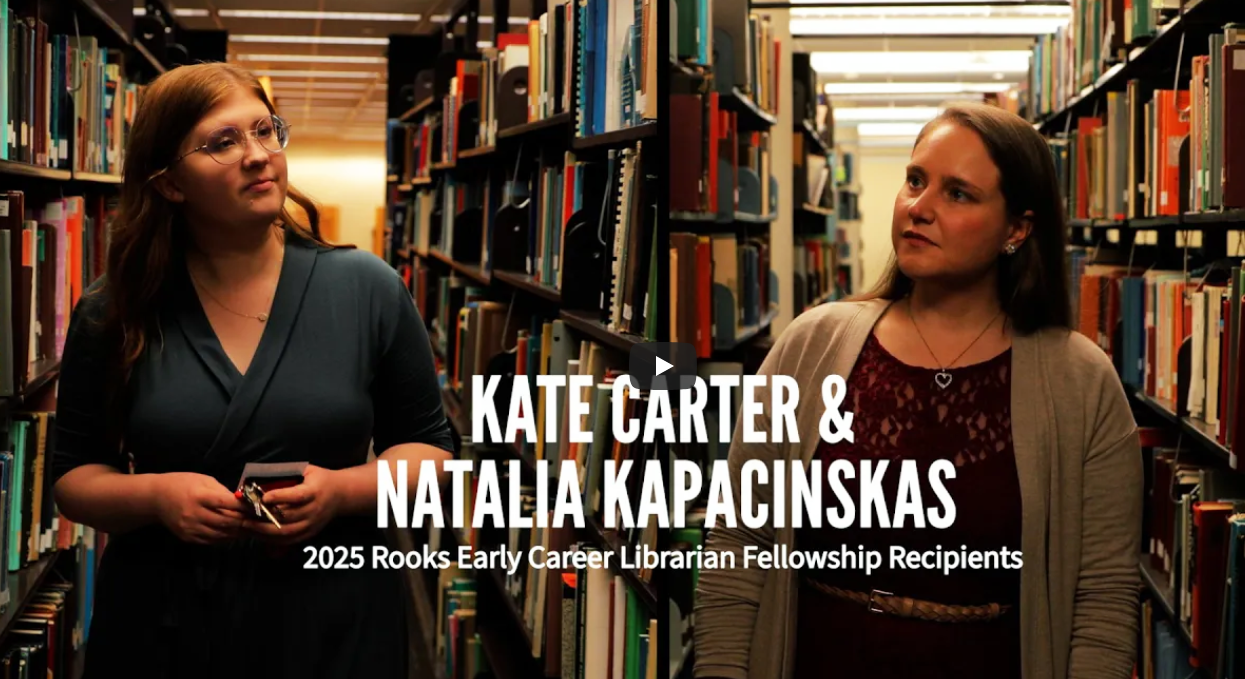
2025 Rooks Early Career Librarian Fellowship Recipients
Remembering Robin Nelson Downes
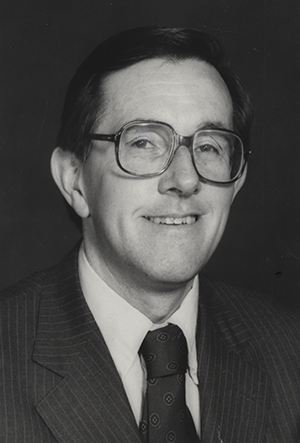
Robin Nelson Downes (1932 – 2025)
Robin Nelson Downes, former Director of University of Houston Libraries, passed away on Wednesday, December 3, 2025, in Houston, Texas. He was 93 years old.
Downes was named Director in 1980, a position he held until his retirement in 1997. Under Downes’ leadership, computer technology became the foundation for library operations, elevating the Libraries as a driver of digital initiatives at the University. He was central to implementing digitization of the card catalog and other academic content. Through innovative applications, Downes expanded the scope and accessibility of library resources and set a strong foundation for the growth of forward-thinking, 21st-century services.
Downes advocated for the electronic publishing of scholarship, and supported the development of an open access journal about end-user computer systems in libraries titled “The Public-Access Computer Systems Review,” established in 1989 at a time when university libraries were among the first publishers of online scholarly journals. He also established a method for applying systems technology to the ways in which the library provided reference services.
Over the course of his leadership, Downes cultivated a professional environment that encouraged creative problem-solving with a focus on stewardship of library resources for students, faculty, and the scholarly community.
“Robin Downes will be remembered as a steady, visionary leader whose influence helped shape the University of Houston Libraries into the essential academic partner it is today,” said Christina H. Gola, Dean of UH Libraries and Elizabeth D. Rockwell Chair. “During his tenure as Director, he not only positioned the Libraries as a critical unit on our campus, but also elevated our engagement at the national level during a period of profound transformation in librarianship. Colleagues who knew him best describe him as interesting, innovative, and exceptionally smart, qualities that guided his work as he embraced automation. His legacy continues to resonate today.”
Downes served in the US Army from 1954 to 1956, and earned a bachelor of arts degree from Florida State University in 1954 and a master’s degree in Library Sciences in 1957. A former librarian at University of Georgia, Downes came to UH from the University of Michigan Library where he was an Associate Director in 1972.
Call for Applications: Open Education Incentive Program
University of Houston Libraries is now accepting applications for the Open Education Incentive (OPEN) Program. The OPEN Program includes a variety of funding opportunities to support engagement with open educational resources (OER) and open educational practices.
Instructors can apply for the following award categories:
- Textbook Affordability Incentive: Instructors can receive funds to replace a required commercial textbook in their course(s) with OER and/or no-cost alternative resources, such as library licensed or freely available resources. Awards in this category range from $1,000 to $5,000.
- Open Educational Practices Incentive: Instructors can receive funds for: 1) creating openly licensed learning objects, 2) replacing a traditional assignment with a renewable assignment, or 3) some combination of the above. Awards in this category range from $500 to $2,000.
OER are teaching and learning resources that are in the public domain or have been licensed in such a way that allows anyone to freely use, modify, and re-purpose them. Open educational practices leverage OER to enhance student learning, and include the creation, use, and reuse of OER, and open pedagogical practices, such as renewable assignments.
The deadline to apply is Friday, March 6, 2026. Interested applicants are encouraged to attend an information session on February 11 to learn about the incentive program and the benefits of open education.
Faculty and instructors may also make an appointment with Open Education Services to discuss implementing OER and the support provided through the incentive program.
ETD in MS Word Accessibility Workshop Series
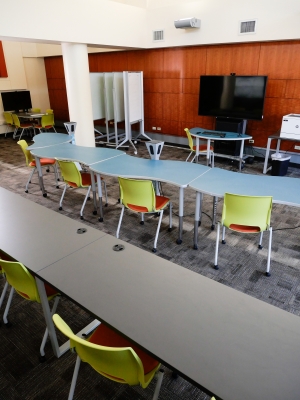
Digital Research Commons
University of Houston Libraries will be hosting six ETD in MS Word Accessibility Training workshops in Spring 2026 at the Digital Research Commons (DRC), located on the second floor of MD Anderson Library (Brown Wing, Room 266-C).
These workshops are open to all UH graduate students and are being offered in response to the U.S. Department of Justice’s Final Rule on Title II of the Americans with Disabilities Act, published in the Federal Register on April 24, 2024. This workshop will teach the best ways to make electronic theses and dissertations (ETDs) created in MS Word accessible to everyone. You will learn how to structure documents so that they can be read by screen readers and meet required accessibility standards.
For each session, the first hour covers the main ideas about accessibility elements and best practices in ETDs. This includes using the styles and headings, adding alt-text and captions to images, making tables and links easy to use, using colors and contrast in the right way, and using Word’s Accessibility Checker.
In the second hour, you will work on your own documents on your own, but you can get help if you need it.
Please register to select your preferred session.
If you have any questions, please contact Xiao Zeng, open publishing librarian.
Media Mentions: Tommy Tune Collection
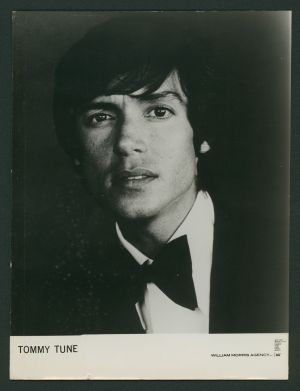
Tommy Tune’s portrait from William Morris Agency
The announcement of the Tommy Tune Collection acquisition at University of Houston Libraries has garnered strong media coverage. Materials documenting the life and career of the prolific dancer/singer/director/choreographer are currently being processed, and will be accessible for research at a future date.
Thomas James Tune was born in Wichita Falls and grew up in Houston where he attended Lamar High School. After graduating from University of Texas at Austin, the 6 foot 6 tap dancer began graduate studies in directing at University of Houston, but soon left Texas for New York City, where his career launched from day one. In 1965, Tune made his Broadway debut in the production of Baker Street, followed by A Joyful Noise (1966) and How Now, Dow Jones (1967).
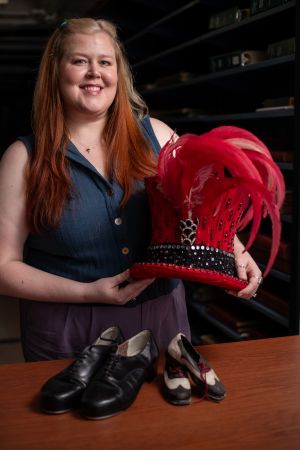
Assistant university archivist Katy Allred carefully checks each item of the Tommy Tune collection to ensure proper preservation.
The acquisition was facilitated by Mary Manning, university archivist, together with Christian Kelleher, head of UH Special Collections. Manning sees a host of opportunities for how the Tommy Tune Collection can advance academic and scholarly productivity. “The Tommy Tune Collection is a significant contribution to the study of theatre history, particularly musical theatre,” she said. “Tommy Tune is not only a talented singer, actor, and dancer, but also a celebrated director, producer, and choreographer; his archives will be enlightening to scholars and performers researching any of these fields. The collection will provide insight into Tune’s creative processes and provide cultural context for the plays he directed and performed in; it can serve as a source for reconstructing the plays and performances, inspiring and providing material for musical theatre students and professionals.”
“Broadway legend donates personal collection to University of Houston” – Houston Chronicle, January 8
“Tommy Tune Collection Finds a Home at the University of Houston” – Broadway World, January 8
“Tommy Tune’s Archives Will Be Housed at the University of Houston” – Playbill, January 8
“Broadway legend Tommy Tune donates his costumes, scripts, letters to University of Houston” – Houston Public Media, January 9
“Houston-born Broadway legend donates 50,000 item personal collection to UH” – CultureMap Houston, January 9
Hello Houston – Houston Public Media, January 22
“Tommy Tune’s personal archive at the University of Houston” – ABC13 Houston Localish, February 2
Visualizing the Future: UH Libraries’ Latest Publication
University of Houston Libraries announces the release of its newest publication, Reimagined, with narratives that explore key initiatives and projects related to the Reimagined Library vision.
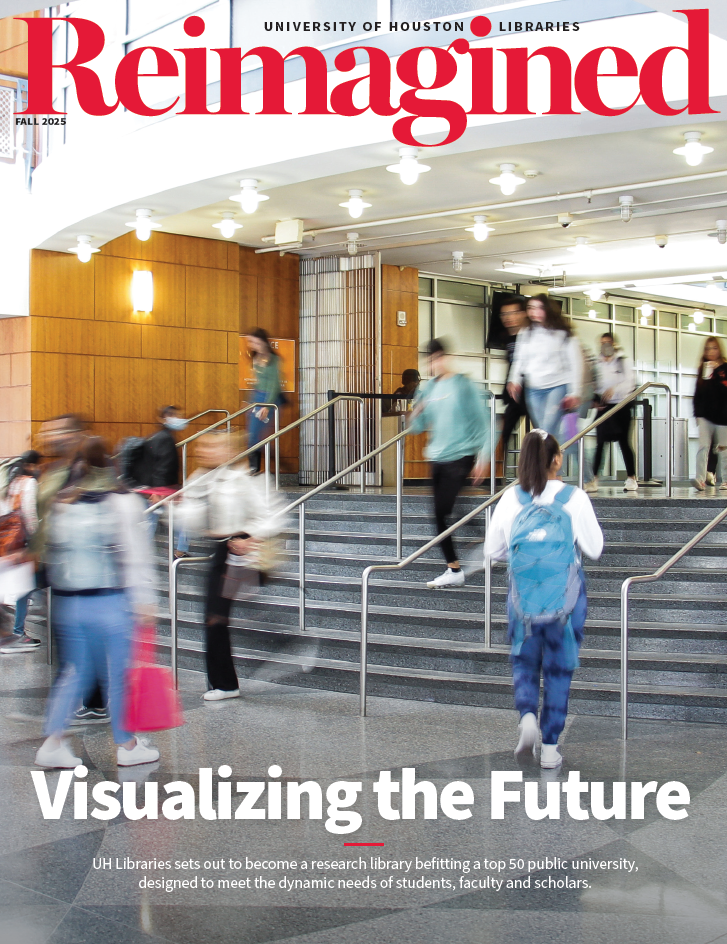
Featuring stories of student success, a signature collection, campus partnerships, and more, Reimagined celebrates the legacy of the Libraries while looking ahead. Designed to inspire dialogue and collaboration, the publication reflects the evolving role of libraries in higher education and offers readers a fresh perspective on how UH Libraries is helping shape the future of learning.
On April 1, 2026, UH Libraries will honor the 75th anniversary of the dedication of MD Anderson Library. We’re reflecting on the history and impact of our Library as we look toward the future, and we invite the UH community to join us in celebrating this auspicious milestone. Watch this space for an announcement of our slate of festivities.
New Digital Preservation Librarian
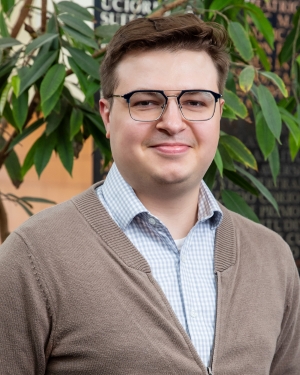
Jeremy Davet is the new digital preservation librarian at UH Libraries.
University of Houston Libraries is pleased to welcome Jeremy Davet as the new digital preservation librarian.
Please describe your role. How does your work align with the student success and research productivity focus of the University?
As the Digital Preservation Librarian for the University of Houston and its libraries, my responsibilities primarily include implementing and periodically amending the UH Libraries Digital Preservation Policy to reflect best practices; managing the Archivematica digital preservation system; and facilitating access to and the use of outmoded digital file types and storage media. When a student’s information-seeking leads them back to the earlier days of personal computing, effective digital preservation will ensure that they can find and use what they are looking for.
Please share a bit about your background and professional interests. How do these inspire and shape your approach to preservation?
Before I started on my current path, my academic background was in cultural anthropology and archaeology. In my experiences navigating divides in language, lived experience, and time, I came to appreciate how much we stand to lose owing to misunderstanding and misremembrance. It was my desire to reveal and preserve the past that took me into libraries and archives – and that’s where you find me today, working to ensure that the archaeologists of tomorrow will be able to uncover the digital artifacts of today. Before joining University of Houston Libraries, I lent my hand to the International Research on Permanent Authentic Records in Electronic Systems (InterPARES), researching the potential benefits and hazards to employing artificial intelligence in memory institutions. More recently, I managed and archived the Artists Documentation Program (ADP), a conservation-focused series of oral histories with artists and their collaborators sponsored by The Menil Collection. In both cases, I was exploring how libraries, archives, and museums can use new technologies to enhance and expand access to their collections, while preserving what makes them authentic and unique.
Taken together, these experiences continue to color my approach to digital preservation: foregrounding the human learning experience, while leveraging emerging technology to improve the quality, quantity, and durability of information.
What are one or two things you’d like faculty, students, and scholars to know about the function/purpose/significance of digital preservation?
Most importantly, that digital preservation is your concern too! Ancient history is not so different from the modern day, insofar as we can only collectively remember what gets recorded. Make sure your work makes it to the next generations by taking simple steps like limiting the length of filenames, regularly backing up your work, and describing your files with metadata. Ensure that you’re adequately safeguarding your files against potential hazards, like hardware failure or natural disasters, and that you’re saving your most important documents in stable, portable formats like PDF.
Open Education Services Collaborates with two faculty members to receive Open Pedagogy Certification
Two faculty members collaborated with the UH Libraries Open Education Services department to complete the Certificate in Open Pedagogy program offered by the Open Education Network (OEN).
The Certificate in Open Pedagogy is a guided, team-based professional development program designed to help a faculty member and a faculty partner (either a librarian or instructional designer) to learn more about open pedagogy, a teaching approach that engages students in co-creation of open educational resources (OER).
The year-long program began in the early spring with a 9-week online course in which participants reviewed readings and videos, engaged with discussion prompts, and created a personalized action plan. This action plan becomes a customized map for how the faculty member, with the partner’s support, will implement an impactful open pedagogy project within a course in the following fall semester. The coursework phase concluded with a Project Symposium, where participants shared their action plans with other members of the cohort to showcase their work and gather feedback.
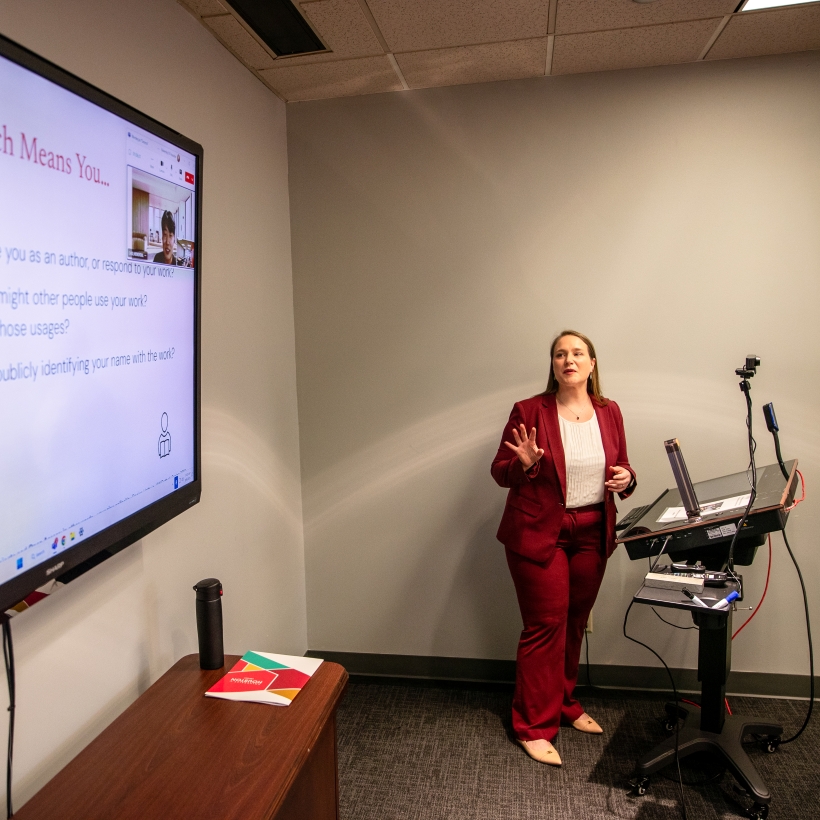
Open education librarian Kate McNally Carter instructs on creative commons licensing to the students in Dr. DeFranco’s Teaching Methods in Hospitality Administration course.
Kate McNally Carter, Open Education Librarian, partnered with Dr. Agnes DeFranco (Professor, Conrad N. Hilton Distinguished Chair, Conrad N. Hilton College of Global Hospitality Leadership) and Dr. Emese Felvégi (Executive Director of Digital Learning and Senior Professor of Practice, C.T. Bauer College of Business) to complete the online program, and are continuing their collaboration into the fall semester with two open pedagogy projects.
Dr. DeFranco and Dr. Felvégi each co-developed an Action Plan with Carter for one of their respective courses, focusing on transforming an existing course assignment into an opportunity for students to create valuable teaching and learning resources that they could elect to publish openly. Inviting students to share their work benefits other students who may be able to learn from, and in some cases build upon, those resources, creating enduring impacts for student learning.
Dr. DeFranco chose to adapt an assignment for her doctoral Teaching Methods in Hospitality Administration course. Previously, students analyzed the educational philosophy of a prominent scholar, drafted their own teaching philosophy, and then compared their philosophy with the selected scholar. In the transformed assignment, students are encouraged to develop a formal presentation with a variety of media and publish this along with their written educational philosophy. DeFranco piloted her action plan over the summer and is formally launching it with her students in the fall.
“Student success is the goal of any educator, regardless of discipline,” DeFranco says. “It is important for an aspiring professor to find their own philosophy by studying those of prominent education influencers and then share it with their students. This builds trust in the learning environment and provides reflective opportunities for them to continuously adapt and align their teaching to new knowledge and challenges.
“To be able to share their philosophies openly,” DeFranco continues, “the PhD students can further hone their pedagogical choices and receive feedback from a wide educational community of scholars. It is very heartwarming to see how much time and thought that they put in for this exercise in our class.”
Dr. Felvégi leveraged the certificate program to further her knowledge of open pedagogy, having used the teaching approach in previous courses through the UH Libraries’ Open Education Incentive (OPEN) Program. For this certificate, her action plan focused on refining an existing open pedagogy assignment in her undergraduate Business Computer Applications course. Felvégi has assigned students in her Honors course to develop learning modules and ancillary materials based on existing OER. Students were invited to engage with a variety of media to develop a wide range of learning materials that could be used in future courses.
“The perspectives of our students on contemporary business topics or practices combined with their creative approach to the ancillaries in Canvas and Pressbooks have been terrific for me to observe and learn from,” Felvégi says. “For the student groups, their ability to pool their own educational experiences and create something new with or about generative AI held useful lessons on collaborations not only among peers, but also between humans and machines.”
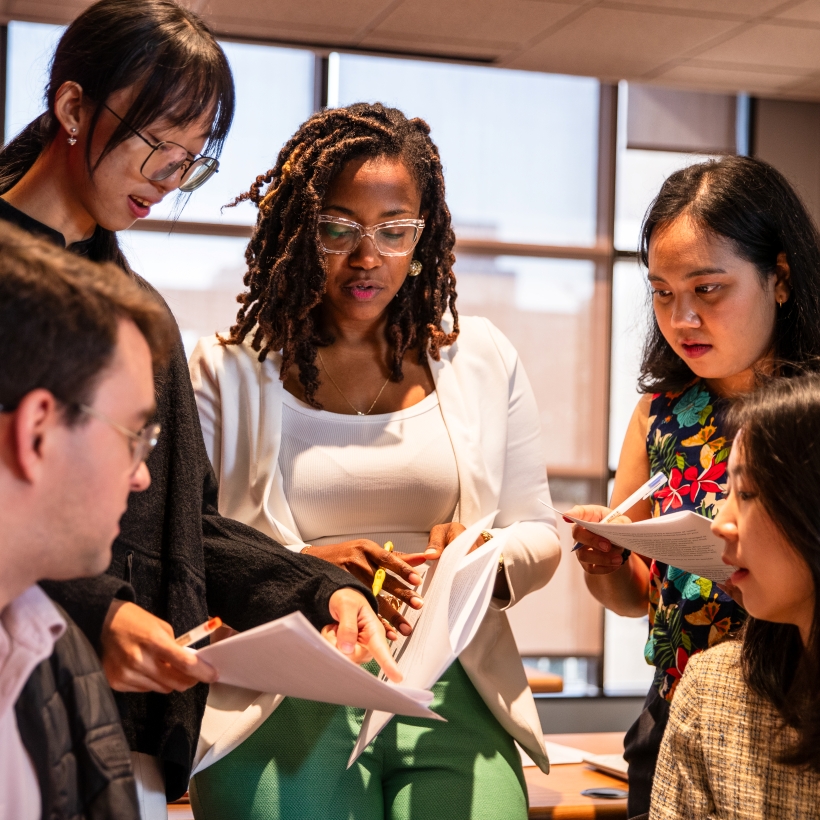
Students in Dr. DeFranco’s course
During the coursework portion of the program, Carter, DeFranco, and Felvégi met weekly to discuss the curriculum, the assignments for the week, and the two action plans, forming an informal learning community around the program and supporting each other by discussing how they could improve upon their open pedagogy assignments.
“Having both instructors from different colleges with different perspectives really enhanced the professional development experience for all of us,” Carter noted. “We were able to learn from each other, especially at the beginning when brainstorming initial ideas for the action plans and how the assignments would be redesigned. The Certificate curriculum was helpful in not only introducing the essential concepts behind effective implementation of open pedagogy, but also equipping instructors with necessary tools to get started with it.”
DeFranco noted her appreciation for the Certificate curriculum and how it has impacted her teaching. “Participating in the program allows me to gain a better understanding of open pedagogy and open educational resources,” she says. “This is now an integral topic of my class.”
This fall, the high-enrollment mass sections of the Business Computer Applications course are learning with student-created materials from a previous semester, using them as engaging low-stakes formative assessments. Current students are learning from the experiences of seniors who weaved their own learning journeys into their modules to encourage current students to follow in their footsteps. These lessons put a spin on traditional textbook content and make them relevant and more personal.
“It has been a great experience working with Agnes and Emese’s classes this fall,” Carter added. “The students have been engaged and interested in the opportunity that open publishing provides. After a class is over, it’s gratifying to be able to showcase something you worked hard on and know that it’s benefitting others, and open pedagogy has an opportunity to give students that experience.”
The option to publish their work openly gives students an opportunity for their work to have a purpose beyond coursework. As DeFranco puts it, “By sharing with others, the project becomes more real. It is now not just a class project, but it is their own professional identity. This work is not for me nor for a grade, but it is for them, and for their future students.”
To learn more about teaching with open pedagogy, contact Open Education Services by emailing [email protected].
On Display: Go, Coogs, Go

Go, Coogs, Go: A Celebration of UH Fall Sports