Media Mentions: Tommy Tune Collection
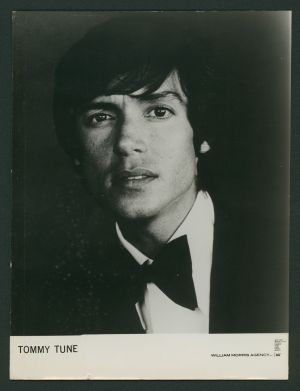
Tommy Tune’s portrait from William Morris Agency
The announcement of the Tommy Tune Collection acquisition at University of Houston Libraries has garnered strong media coverage. Materials documenting the life and career of the prolific dancer/singer/director/choreographer are currently being processed, and will be accessible for research at a future date.
Thomas James Tune was born in Wichita Falls and grew up in Houston where he attended Lamar High School. After graduating from University of Texas at Austin, the 6 foot 6 tap dancer began graduate studies in directing at University of Houston, but soon left Texas for New York City, where his career launched from day one. In 1965, Tune made his Broadway debut in the production of Baker Street, followed by A Joyful Noise (1966) and How Now, Dow Jones (1967).
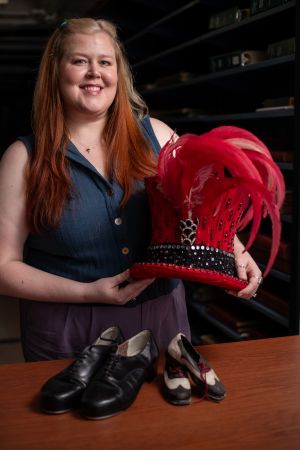
Assistant university archivist Katy Allred carefully checks each item of the Tommy Tune collection to ensure proper preservation.
The acquisition was facilitated by Mary Manning, university archivist, together with Christian Kelleher, head of UH Special Collections. Manning sees a host of opportunities for how the Tommy Tune Collection can advance academic and scholarly productivity. “The Tommy Tune Collection is a significant contribution to the study of theatre history, particularly musical theatre,” she said. “Tommy Tune is not only a talented singer, actor, and dancer, but also a celebrated director, producer, and choreographer; his archives will be enlightening to scholars and performers researching any of these fields. The collection will provide insight into Tune’s creative processes and provide cultural context for the plays he directed and performed in; it can serve as a source for reconstructing the plays and performances, inspiring and providing material for musical theatre students and professionals.”
“Broadway legend donates personal collection to University of Houston” – Houston Chronicle, January 8
“Tommy Tune Collection Finds a Home at the University of Houston” – Broadway World, January 8
“Tommy Tune’s Archives Will Be Housed at the University of Houston” – Playbill, January 8
“Broadway legend Tommy Tune donates his costumes, scripts, letters to University of Houston” – Houston Public Media, January 9
“Houston-born Broadway legend donates 50,000 item personal collection to UH” – CultureMap Houston, January 9
Hello Houston – Houston Public Media, January 22
“Tommy Tune’s personal archive at the University of Houston” – ABC13 Houston Localish, February 2
Visualizing the Future: UH Libraries’ Latest Publication
University of Houston Libraries announces the release of its newest publication, Reimagined, with narratives that explore key initiatives and projects related to the Reimagined Library vision.
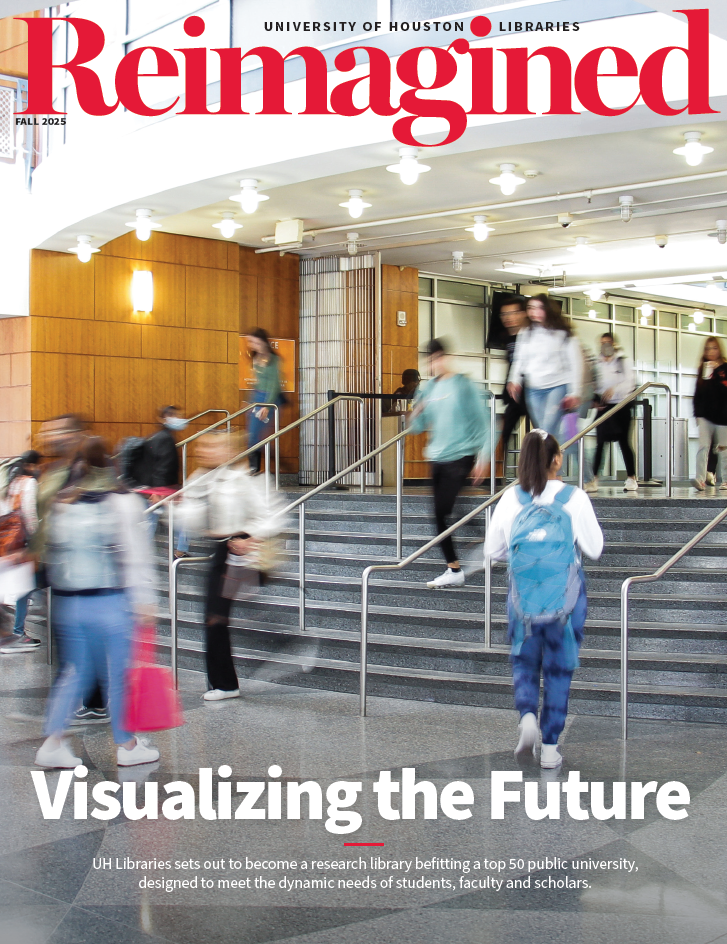
Featuring stories of student success, a signature collection, campus partnerships, and more, Reimagined celebrates the legacy of the Libraries while looking ahead. Designed to inspire dialogue and collaboration, the publication reflects the evolving role of libraries in higher education and offers readers a fresh perspective on how UH Libraries is helping shape the future of learning.
On April 1, 2026, UH Libraries will honor the 75th anniversary of the dedication of MD Anderson Library. We’re reflecting on the history and impact of our Library as we look toward the future, and we invite the UH community to join us in celebrating this auspicious milestone. Watch this space for an announcement of our slate of festivities.
New Digital Preservation Librarian
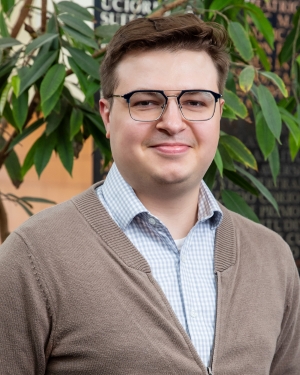
Jeremy Davet is the new digital preservation librarian at UH Libraries.
University of Houston Libraries is pleased to welcome Jeremy Davet as the new digital preservation librarian.
Please describe your role. How does your work align with the student success and research productivity focus of the University?
As the Digital Preservation Librarian for the University of Houston and its libraries, my responsibilities primarily include implementing and periodically amending the UH Libraries Digital Preservation Policy to reflect best practices; managing the Archivematica digital preservation system; and facilitating access to and the use of outmoded digital file types and storage media. When a student’s information-seeking leads them back to the earlier days of personal computing, effective digital preservation will ensure that they can find and use what they are looking for.
Please share a bit about your background and professional interests. How do these inspire and shape your approach to preservation?
Before I started on my current path, my academic background was in cultural anthropology and archaeology. In my experiences navigating divides in language, lived experience, and time, I came to appreciate how much we stand to lose owing to misunderstanding and misremembrance. It was my desire to reveal and preserve the past that took me into libraries and archives – and that’s where you find me today, working to ensure that the archaeologists of tomorrow will be able to uncover the digital artifacts of today. Before joining University of Houston Libraries, I lent my hand to the International Research on Permanent Authentic Records in Electronic Systems (InterPARES), researching the potential benefits and hazards to employing artificial intelligence in memory institutions. More recently, I managed and archived the Artists Documentation Program (ADP), a conservation-focused series of oral histories with artists and their collaborators sponsored by The Menil Collection. In both cases, I was exploring how libraries, archives, and museums can use new technologies to enhance and expand access to their collections, while preserving what makes them authentic and unique.
Taken together, these experiences continue to color my approach to digital preservation: foregrounding the human learning experience, while leveraging emerging technology to improve the quality, quantity, and durability of information.
What are one or two things you’d like faculty, students, and scholars to know about the function/purpose/significance of digital preservation?
Most importantly, that digital preservation is your concern too! Ancient history is not so different from the modern day, insofar as we can only collectively remember what gets recorded. Make sure your work makes it to the next generations by taking simple steps like limiting the length of filenames, regularly backing up your work, and describing your files with metadata. Ensure that you’re adequately safeguarding your files against potential hazards, like hardware failure or natural disasters, and that you’re saving your most important documents in stable, portable formats like PDF.
Open Education Services Collaborates with two faculty members to receive Open Pedagogy Certification
Two faculty members collaborated with the UH Libraries Open Education Services department to complete the Certificate in Open Pedagogy program offered by the Open Education Network (OEN).
The Certificate in Open Pedagogy is a guided, team-based professional development program designed to help a faculty member and a faculty partner (either a librarian or instructional designer) to learn more about open pedagogy, a teaching approach that engages students in co-creation of open educational resources (OER).
The year-long program began in the early spring with a 9-week online course in which participants reviewed readings and videos, engaged with discussion prompts, and created a personalized action plan. This action plan becomes a customized map for how the faculty member, with the partner’s support, will implement an impactful open pedagogy project within a course in the following fall semester. The coursework phase concluded with a Project Symposium, where participants shared their action plans with other members of the cohort to showcase their work and gather feedback.
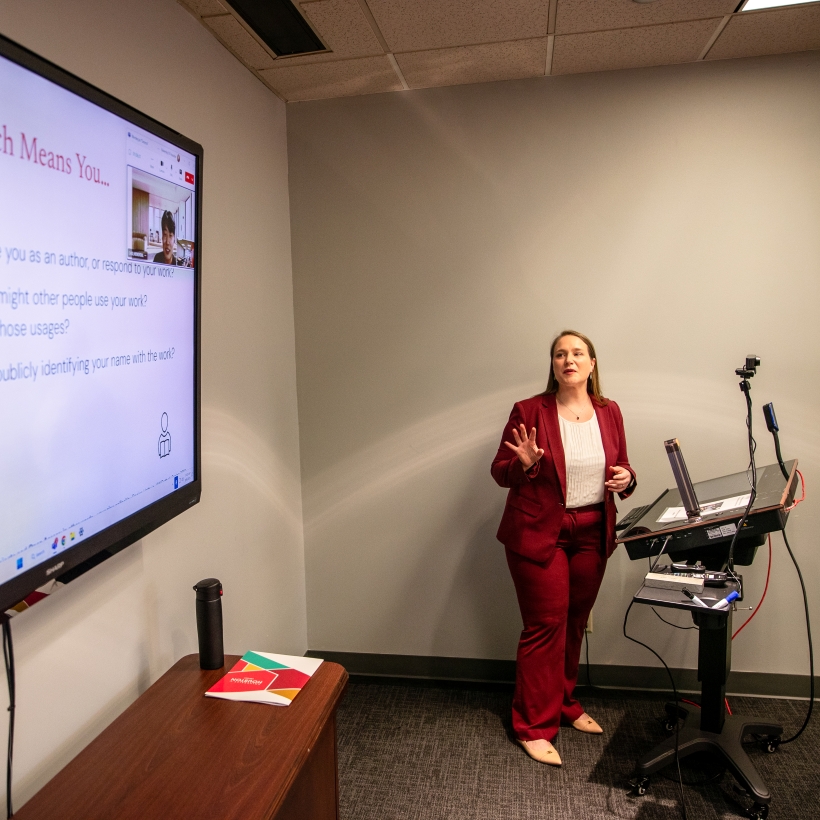
Open education librarian Kate McNally Carter instructs on creative commons licensing to the students in Dr. DeFranco’s Teaching Methods in Hospitality Administration course.
Kate McNally Carter, Open Education Librarian, partnered with Dr. Agnes DeFranco (Professor, Conrad N. Hilton Distinguished Chair, Conrad N. Hilton College of Global Hospitality Leadership) and Dr. Emese Felvégi (Executive Director of Digital Learning and Senior Professor of Practice, C.T. Bauer College of Business) to complete the online program, and are continuing their collaboration into the fall semester with two open pedagogy projects.
Dr. DeFranco and Dr. Felvégi each co-developed an Action Plan with Carter for one of their respective courses, focusing on transforming an existing course assignment into an opportunity for students to create valuable teaching and learning resources that they could elect to publish openly. Inviting students to share their work benefits other students who may be able to learn from, and in some cases build upon, those resources, creating enduring impacts for student learning.
Dr. DeFranco chose to adapt an assignment for her doctoral Teaching Methods in Hospitality Administration course. Previously, students analyzed the educational philosophy of a prominent scholar, drafted their own teaching philosophy, and then compared their philosophy with the selected scholar. In the transformed assignment, students are encouraged to develop a formal presentation with a variety of media and publish this along with their written educational philosophy. DeFranco piloted her action plan over the summer and is formally launching it with her students in the fall.
“Student success is the goal of any educator, regardless of discipline,” DeFranco says. “It is important for an aspiring professor to find their own philosophy by studying those of prominent education influencers and then share it with their students. This builds trust in the learning environment and provides reflective opportunities for them to continuously adapt and align their teaching to new knowledge and challenges.
“To be able to share their philosophies openly,” DeFranco continues, “the PhD students can further hone their pedagogical choices and receive feedback from a wide educational community of scholars. It is very heartwarming to see how much time and thought that they put in for this exercise in our class.”
Dr. Felvégi leveraged the certificate program to further her knowledge of open pedagogy, having used the teaching approach in previous courses through the UH Libraries’ Open Education Incentive (OPEN) Program. For this certificate, her action plan focused on refining an existing open pedagogy assignment in her undergraduate Business Computer Applications course. Felvégi has assigned students in her Honors course to develop learning modules and ancillary materials based on existing OER. Students were invited to engage with a variety of media to develop a wide range of learning materials that could be used in future courses.
“The perspectives of our students on contemporary business topics or practices combined with their creative approach to the ancillaries in Canvas and Pressbooks have been terrific for me to observe and learn from,” Felvégi says. “For the student groups, their ability to pool their own educational experiences and create something new with or about generative AI held useful lessons on collaborations not only among peers, but also between humans and machines.”
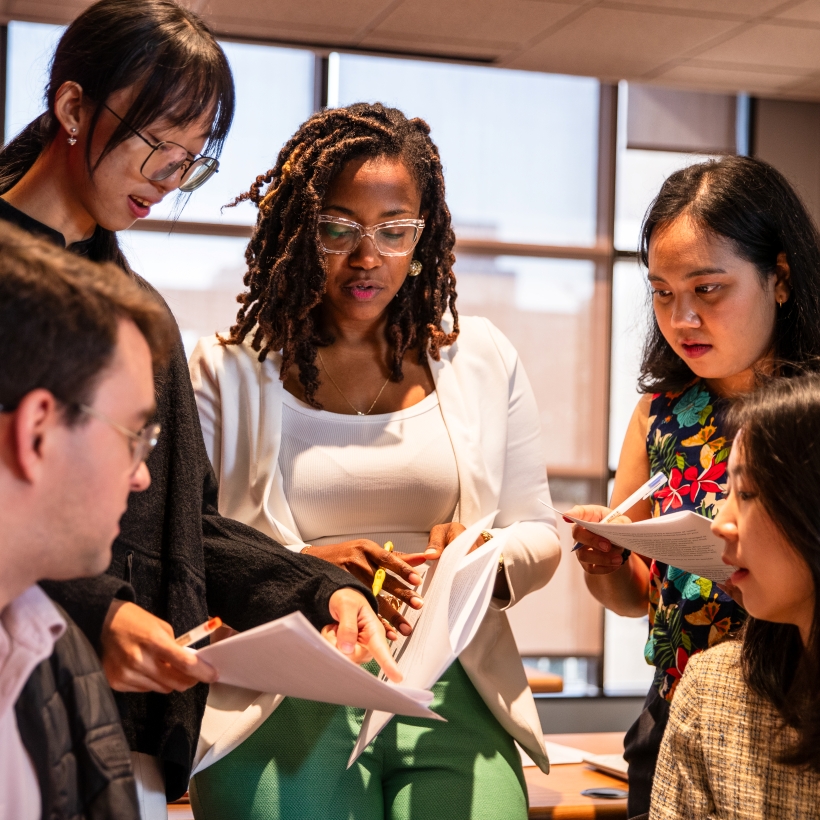
Students in Dr. DeFranco’s course
During the coursework portion of the program, Carter, DeFranco, and Felvégi met weekly to discuss the curriculum, the assignments for the week, and the two action plans, forming an informal learning community around the program and supporting each other by discussing how they could improve upon their open pedagogy assignments.
“Having both instructors from different colleges with different perspectives really enhanced the professional development experience for all of us,” Carter noted. “We were able to learn from each other, especially at the beginning when brainstorming initial ideas for the action plans and how the assignments would be redesigned. The Certificate curriculum was helpful in not only introducing the essential concepts behind effective implementation of open pedagogy, but also equipping instructors with necessary tools to get started with it.”
DeFranco noted her appreciation for the Certificate curriculum and how it has impacted her teaching. “Participating in the program allows me to gain a better understanding of open pedagogy and open educational resources,” she says. “This is now an integral topic of my class.”
This fall, the high-enrollment mass sections of the Business Computer Applications course are learning with student-created materials from a previous semester, using them as engaging low-stakes formative assessments. Current students are learning from the experiences of seniors who weaved their own learning journeys into their modules to encourage current students to follow in their footsteps. These lessons put a spin on traditional textbook content and make them relevant and more personal.
“It has been a great experience working with Agnes and Emese’s classes this fall,” Carter added. “The students have been engaged and interested in the opportunity that open publishing provides. After a class is over, it’s gratifying to be able to showcase something you worked hard on and know that it’s benefitting others, and open pedagogy has an opportunity to give students that experience.”
The option to publish their work openly gives students an opportunity for their work to have a purpose beyond coursework. As DeFranco puts it, “By sharing with others, the project becomes more real. It is now not just a class project, but it is their own professional identity. This work is not for me nor for a grade, but it is for them, and for their future students.”
To learn more about teaching with open pedagogy, contact Open Education Services by emailing [email protected].
On Display: Go, Coogs, Go

Go, Coogs, Go: A Celebration of UH Fall Sports
Video: Ask an Archivist
For #AskAnArchivist Day and American Archives Month, we asked three UH archivists to share a bit about their work. In this video, Katy Allred, assistant university archivist for the Centennial project; Vince Lee, archivist for the Carey Shuart Women’s Research Collection; and Mary Manning, University of Houston archivist, talk about how they got into the field of archives, what a typical workday looks like, and some of their current projects.
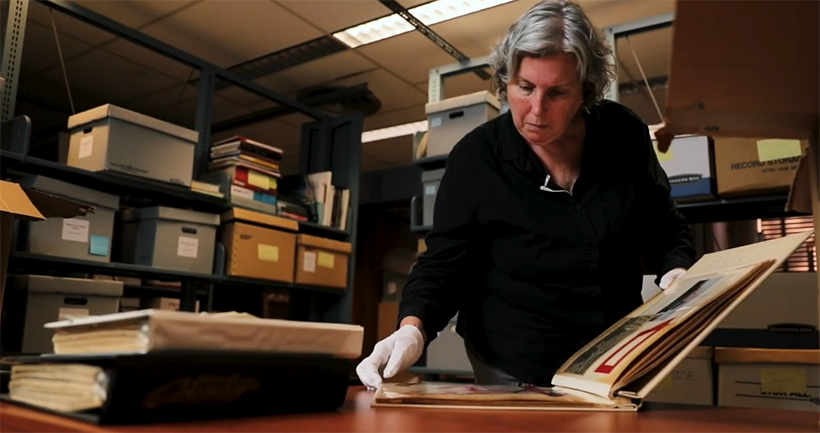
University archivist Mary Manning
UH Libraries Announces the Suzanne Paul Collection
UH Libraries thanks Deborah Colton for her contributions to this announcement.
University of Houston Libraries Special Collections is pleased to announce the donation of the Suzanne Paul Collection.
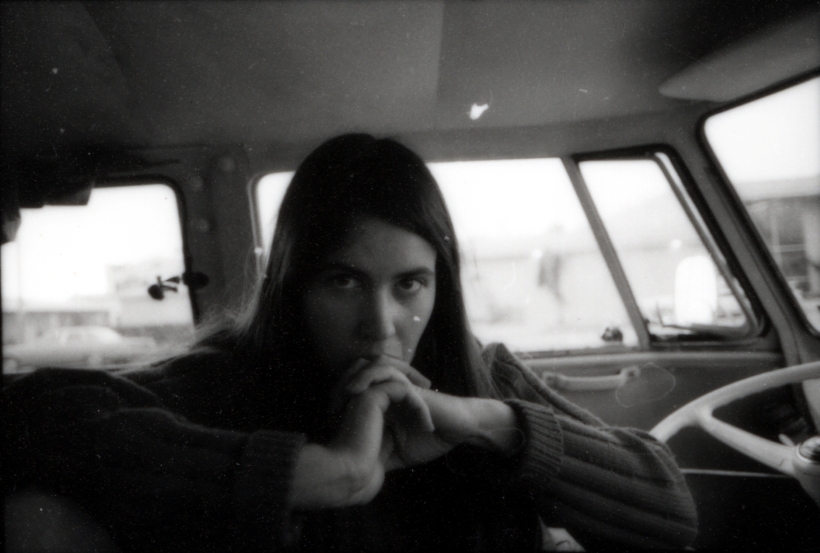
Image of the photographer Suzanne Paul, circa 1970s, sourced from a contact sheet
Suzanne Paul (1945 – 2005), a native Houstonian and pioneering female photographer, has made a vast contribution to representing the arts of Houston and to recording Houston’s art history. Through pure creative impetus and respect for the arts in the city, Suzanne photographed the heartbeat of Houston’s art scene from the mid-1970’s through the beginning of the millennium. This collection has now been generously donated by Suzanne’s daughter, Mercedes Mallard Paul.
Paul’s introduction to the arts of Houston started in 1976 when James Harithas, who was then the Director of the Contemporary Arts Museum (CAMH) commissioned her to take photographs of artists and their art installations at the museum. Shortly thereafter, she was offered the first solo exhibition of a female artist there, which featured her photographs. Suzanne was always at every art happening that was significant in the city, carefully taking photos and capturing the essence and soul of each event.
In revealing ways, Suzanne Paul has documented the artists, the curators, the gallery owners and patrons of that era. The people who shaped and defined Houston’s rapid growth and helped the arts flourish, which set the stage for who we have become as a vibrant art city today.
Among the first artists Paul photographed were Dick Wray, Julian Schnabel, Terry Allen and Norman Bluhm. Soon after, she documented Richard Stout, Bert L. Long Jr., Jesse Lott, The Art Guys, Mel Chin and Edward Albee. In addition to her portraitures of artists and long-time friends, Paul captured photographs of museum curators like Anne Tucker, Walter Hopps, Alison de Lima Green and Edward Mayo, and patrons starting art nonprofits at the time, like Ann Harithas, Marilyn Oshman and others. So many art celebrities and patrons on this era were photographed through Paul’s skillful lens. Without Suzanne Paul’s photographic documentation of this incredible growth era of the arts in Houston, so much of this period would be lost.
This collection of photographic negative, slides, prints and related memorabilia from this work was left in the care of Deborah Colton – Deborah Colton Gallery since the artist’s passing in 2005. At the request of Suzanne’s daughter, Deborah Colton Gallery hosted the Memorial Reception and Exhibition of Suzanne and her work in March of 2005, which was the time of her passing. This important exhibition was at Colton’s gallery at 2500 Summer Street at the time, where hundreds of people from the art community came to pay their respects to this notable artist.
Deborah Colton Gallery, in collaboration with Suzanne’s daughter Mercedes Mallard Paul, worked tirelessly for many years to catalog and preserve Paul’s imagery and related materials, including prints, negatives, slides, press articles, catalogs, and letters. The result is an impactful, tangible record affirming Paul’s distinction and major contribution to Houston’s arts and culture.
As Deborah Colton stated, “I dedicated so much of my staff’s and my time and financial resources to the Suzanne Paul project and protected this Collection for close to two decades. I did this with conviction and long-term dedication because I knew how important it was to Houston’s art history. During the time Suzanne was photographing, she was known to be at anything and everything important in the arts happening in the city. She was the first and the last to put so much of her heart and soul into the documentation of the city’s arts, and such an important time it was: a rapid period of growth, helping shape our arts and culture into the vibrant community that it is today. It has been my long-term goal to see this collection be placed with the Special Collections of the University of Houston Libraries.”
“I believe my mother wanted to capture the art world in Houston because that was her passion,” Mercedes said. “Art and photography were things that she lived and breathed daily.”
Christian Kelleher, current director of exhibitions and external relations and former head of Special Collections, said “the work of Suzanne Paul will prove to be invaluable for research in the arts, women’s history and the history of Houston. This is a special, influential legacy that we are honored to preserve in our collections.”
The Suzanne Paul Collection is a compelling addition to an already rich archive of primary source materials in performing and visual arts. Through UH Special Collections, UH students and faculty, as well as global scholars, can explore records of well-known regional organizations that document theater companies, directors, producers, performers and artists, and art groups.
“Suzanne Paul’s work captures the soul of Houston’s art scene with striking clarity and depth,” said Lauren Gottlieb-Miller, associate dean for Special Libraries and Preservation. “This collection not only preserves her legacy but enriches UH Libraries’ commitment to documenting the city’s cultural history. We are deeply grateful for the dedication of Deborah Colton Gallery and Mercedes Mallard Paul in bringing this invaluable archive to our students, scholars, and community.”
The collection is currently being processed. For information, contact Christian Kelleher.
New Exhibit on the Black Arts Movement Opens at UH Libraries
Recently, University of Houston Libraries hosted an opening reception for the new exhibit “Black Ink: The Black Arts Movement in Print.” Rare Books curator Julie Grob selected materials from UH Special Collections’ significant holdings of poetry and other writing published during the Black Arts Movement period of the 1960s and 70s. A few of the writers featured are Amiri Baraka, Toni Cade Bambara, Gwendolyn Brooks, Nikki Giovanni, and Ntozake Shange. The exhibit also includes examples from the Black-owned publishers Broadside Press of Detroit and the Third World Press of Chicago.

The community engagement event held at the Elizabeth D. Rockwell Pavilion included poetry readings from three graduate students in the UH Creative Writing Program. Abby Mengesha, Anthony Sutton, and El Williams III shared poetry from writers of the Black Arts Movement along with their own works.
Sutton wrote the following introduction to the exhibit:
This mid-twentieth century movement in literature, music, and art coincided with cultural shifts in the post-World War Two United States, including the Civil Rights movement and the Cold War. Through the Black Arts Movement, experimental literary sensibilities emerging at the time met the politics of the Black Panthers.
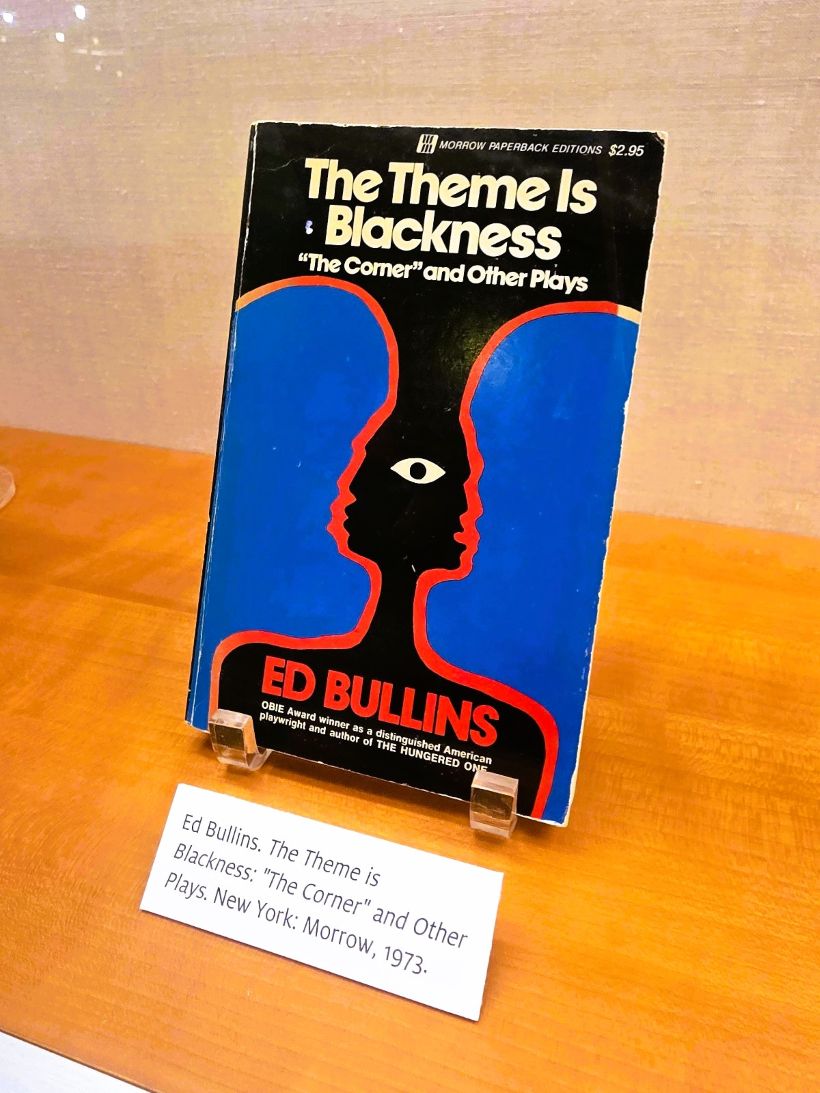
While some members of this grouping, such as Lorraine Hansberry, Amiri Baraka, and Gwendolyn Brooks, achieved mainstream recognition, this movement largely made use of underground and alternative venues such as the Black Arts Repertory Theater and School in Harlem for works to be performed. Print materials from the Black Arts Movement show the DIY publishing possible with a machine called the mimeograph which allowed the production of large volumes of magazines and books quickly and affordably.
The Black Arts Movement was also a nation-wide movement with not only New York City being a hotspot but also significant publishing activity in the Midwest with Broadside Press in Detroit and Third World Press in Chicago. In 2025 Third World Press received the Toni Morrison Achievement Award from the National Book Critics Circle. The Black Arts Movement eventually reached Houston through Lorenzo Thomas who served as Writer-in-Residence at Texas Southern University and later as faculty at UH-Downtown.
Visitors are invited to experience the exhibit, located at MD Anderson Library floor 2, through May 2026.
Announcing 2025 Open Education Incentive Program Award Winners
University of Houston Libraries is pleased to announce the 2025 recipient cohort of the UH Open Education Incentive (OPEN) Program.
Formerly known as the Alternative Textbook Incentive Program, this initiative was launched in 2018 to mitigate the high cost of textbooks for students by supporting instructors in replacing commercial textbooks with open educational resources (OER). Since then, the program has expanded to include additional ways for UH faculty to engage with open education.
Instructors awarded the Textbook Affordability Incentive will adopt, adapt, or create OER, or use a combination of freely available or library-licensed resources, to replace required commercial textbook(s) in a course.
Instructors awarded the Open Educational Practices Incentive will create and share an OER learning object (including assignments, quizzes, lecture slides, lesson plans, videos, or other teaching resources), which benefits both students and other educators who can reuse and repurpose it. This incentive also supports instructors in replacing a traditional assignment with a renewable assignment, implementing what is commonly called open pedagogy, or engaging students in co-creating course content that can be openly licensed and shared.
2025 OPEN Program winners are:
Textbook Affordability:
- Layci Harrison – ATP 6113: Lower Extremity Evaluation Lab & ATP 6123: Upper Extremity Evaluation Lab – College of Liberal Arts & Social Sciences
- Dmitri Litvinov – ECE 3355: Electronics – Cullen College of Engineering
- Julio Cesar Lopez Otero – SPAN 1507: Intensive Elementary Spanish for Heritage Learners – College of Liberal Arts & Social Sciences
- Rita Sharpe – BIOL 4374/BCHS 4313: Cell Biology/Cell Biochemistry (cross-listed) – Honors College
- William Zahn – MARK 4332: Social Media Marketing – C.T. Bauer College of Business
Estimated textbook costs removed for students in the first year of implementing no-cost materials in these courses is $89,000, benefiting an estimated 500 students. Awards were granted based on the number of students impacted, cost of the textbook being replaced, the type of project and type of resources being adopted, and the feasibility of successful implementation.
Open Educational Practices:
- Laura Cizek – COMD 3371: Speech Development and Disorders – College of Liberal Arts & Social Sciences
- David Crawley – TLIM 3330: Innovation Principles – Cullen College of Engineering
- Mary Sykes and Emese Felvégi – ACCT 2301: Principles of Financial Accounting – C.T. Bauer College of Business
These proposals will impact approximately 700 students. Awards were granted based on project goals, feasibility of successful implementation, and anticipated enhancement to student learning.
Additionally, this year the OPEN Program expanded to include an OER Professional Development Incentive in which instructors completed self-paced online learning modules and received a certificate administered by the Texas Higher Education Coordinating Board. Sixteen instructors completed the OER Professional Development Incentive, including instructors from the College of Engineering, College of Natural Sciences & Mathematics, College of Liberal Arts and Social Sciences, C.T. Bauer College of Business, College of Education, Cullen College of Engineering, College of Pharmacy, Conrad N. Hilton College of Global Hospitality Leadership, and the Kathrine G. McGovern College of the Arts. The full list of all award recipients can be found on the OPEN Program webpage.
“I’m excited that we are able to continue expanding awareness of open education through the Open Education Incentive Program,” said Ariana Santiago, head of open education services and interim associate dean for research and student engagement. “Instructors are supporting student success by ensuring they have free access to course materials and developing engaging learning experiences with open pedagogy.”
Learn more about open educational resources at UH.
Special thanks to the members of the 2025 OPEN Program Review Committee: Lu Gao, Edward Gloor, Virginia Sisson, Kate McNally Carter, and Ariana Santiago.
New Data Management Librarian
University of Houston Libraries is pleased to welcome Molly Knapp as the new data management librarian.
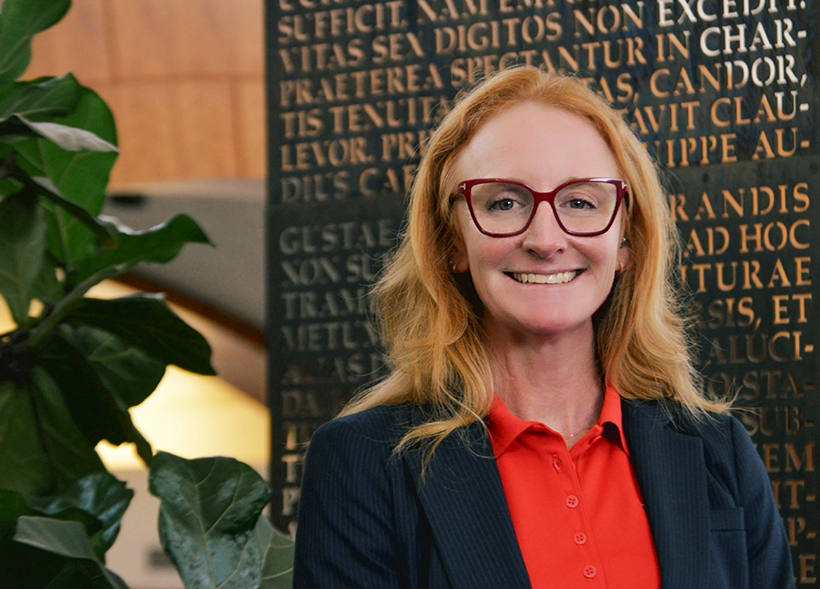
Molly Knapp
Please describe your role. How does your work align with the student success and research productivity focus of the University?
As the UH data management librarian, my responsibilities include leading the expansion of the Libraries’ data management service portfolio; managing and promoting the UH Dataverse Repository (an open access repository for the UH community to share and preserve their research data) and DMPTool (a free service that simplifies creating data management and sharing plans to meet grant funding requirements). I‘m looking forward to growing partnerships across campus to address current and emerging data management needs among faculty, students, and research centers.
Please share a bit about your background and professional interests. How do these inspire and shape your approach to research services?
I bring over 20 years of experience working in academic and health sciences libraries and engaging with students, adult learners, researchers and faculty. I’ve held roles at the Network of the National Library of Medicine (NNLM), Tulane University Rudolph Matas Library of the Health Sciences, and the John P. Isché Library at Louisiana State University Health Sciences Center-New Orleans. At the NNLM I was a primary instructor for classes about Pubmed.gov, the largest free biomedical and research database in the world, and in my opinion, the most important trove of knowledge for anyone working in the sciences. I am inspired by the motto “see one, do one, teach one,” a medical education method originating from American surgeon William Stewart Halsted in the late 19th century, who formalized the apprenticeship model for surgical training at Johns Hopkins Hospital. This approach emphasizes acquiring skills through observation, hands-on practice, and then solidifying that knowledge by teaching it to others. My experiences working in academic medicine and government shape my approach in growing our data management and research services here at UH. As a runner and former New Orleanian, I am also fond of using the motto “it’s a marathon, not a sprint,” to describe everything from 5Ks to Mardi Gras, much to the chagrin of my teenage children.
What are one or two things you’d like faculty, students, and scholars to know about the function/purpose/significance of data management?
Everyone should be interested in data management, because everything we do generates a data point for someone or something, who probably wants to monetize it. I hope to empower our community with awareness and understanding of how to control, monitor, use and share data. Just recently I was introduced to the book You Are a Data Person: Strategies for Using Analytics on Campus by Amelia Parnell, which posits that nearly every campus professional will need to approach their work with a data-informed perspective. The book is free to read through UH Library ebooks, and includes a set of self-assessment questions to see what kind of data identity you may have. I got “Visionary”. So here’s my data vision for the people of UH: Don’t be scared of your data, tame it! If you need ideas on how to do that, come to me.